
Sanjana Singh
Lead
Euro-BioImaging
Next generation imaging for biology across scales
IMAGINE will provide technologies to probe structure and function of biological specimens in their natural context
Technology development within IMAGINE aims at achieving robust, correlative and high-throughput technologies that can be handed over to the RI partners for validation as new and often integrated services (WP7 to WP9). Importantly, the validation partners are closely interlinked with the technology developers, providing the needs of the Life Science user communities from the start to ensure the new technical solutions address them.
The quality-controlled processes for technology integration at the RIs provide a “stamp of approval” to any new technology, tool or workflow, support a quick roll-out and multiplication of services and enable the RIs to act as lighthouses for providing unprecedented access to integrated pipelines (WP11).
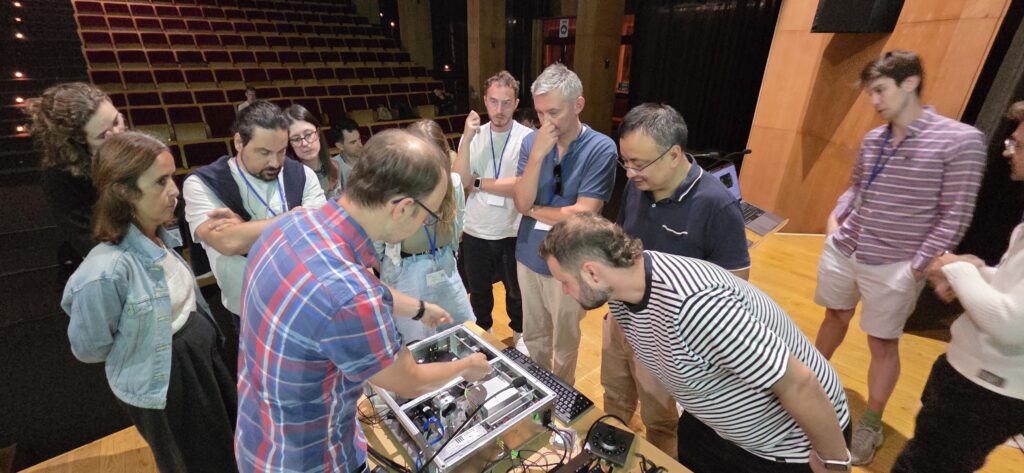
This WP aims at validating the new tools, instruments and methods developed in WP1-6 to user access readiness for newly developed technologies at Euro-BioImaging Nodes. It will emphasize correlative workflows, including for example combining intravital and X-ray imaging, as well as Light Microscopy (LM) and Electron Microscopy (EM).
The work package is led by Euro-BioImaging. Additional partners include Instruct ERIC, and EMBRC ERIC.
Period 1
In this reporting period, WP7 focused on preparing for the validation of bioimaging tools, instruments, and methods from WP1-6 at Euro-BioImaging Nodes. WP7 established strategic links between technology and validation work packages, initiated collaborations with Euro-BioImaging Node experts, and facilitated knowledge exchange through consortium meetings and workshops. Activities included the IMAGINE kick-off meeting, organizing a “IMAGINE for RIs” workshop, compiling a registry of interested Node experts, and disseminating project information via brochures and conference presentations. These efforts laid the groundwork for targeted technology validation, staff training, and one-on-one exchanges between developers and facility experts, particularly in advanced microscopy, electron microscopy, and intravital imaging.
Period 2
In this period, seven validation partners (“Nodes”) were onboarded through a structured matching process with technology developers to initiate the validation process. Joint coordination meetings established clear validation use cases, requirements, and operational guidelines, formalized in Deliverable D7.2. The scope of technology validation was defined to span several domains, including technical performance, user access, workflow integration, service readiness, and scalability. To monitor all these metrics, a modular validation template was developed that defined validation scope, success criteria, and training needs.
Technology validation under Task 7.3 will begin once the use cases are formally finalized.
This WP will implement new workflows at Instruct Centres and nodes, incorporating new tools and methods developed by the technology development WP1-6. Particular focus will be to provide an integrated pathway combining X-ray tomography with cryogenic fluorescence and using milling technology to produce samples for high resolution microscopy.
The work package is led by Instruct ERIC. Additional partners include EMBRC ERIC and Euro-BioImaging.
Period 1
Although WP8’s main activities will start in month 13, preparatory work has already begun to enable validation of new structural biology imaging services. WP8 engaged with technical work packages, especially WP2, to identify services needing testing, define timelines, and establish validation procedures. Close interactions were initiated with other research infrastructures, notably Euro-BioImaging via WP7, to align validation approaches. WP8 also communicated with external Instruct centres to gauge interest in participating in service testing and validation. Additionally, the September 2023 “IMAGINE for RIs” workshop facilitated matchmaking between IMAGINE technology developers and external RI nodes for future validation activities.
Period 2
In WP8, work focused on defining and implementing validation processes for new imaging technologies in structural biology, in close collaboration with Euro-BioImaging (WP7), EMBRC (WP9), and IMAGINE technology developers (WP1-6). Validation partners were identified through virtual matchmaking events, with CEITEC (MU, Czech Republic) supporting plasmaFIB workflows (WP2) and IBS (CNRS, France) validating cryo-SR and cryo-SR-CLEM technologies (WP3). Detailed validation plans were developed to test technical performance, workflow integration, reproducibility, and compatibility with existing service infrastructures, while fostering cross-technology integration and standardization. Site visits, benchmarking, and training strategies were defined, with activities scheduled to begin in early 2026. Deliverables D8.1 and D8.2 formalize these plans and establish the framework for systematic implementation, troubleshooting, and dissemination.
WP9 aims at preparing the relevant tools, instruments and methods developed in WP1-6 for service provision at or in collaboration with EMBRC marine research centres. It will include defining the challenges posed by marine research needs and specificities, adapting the new technologies to the samples of marine origin, and use cases dealing with representative applications for the novel technologies in marine research.
The work package is led by EMBRC-ERIC. Additional partners include EMBRC Node (Sorbonne University), EMBRC Node (Universidad del Pais Vasco-Euskal Herriko Uniberitatea), and EMBRC Node (Universidade de Vigo).

Lead
EMBRC
Period 1
Before the official launch of WP9 in May 2024, preparatory activities focused on establishing regular meetings, engaging EMBRC experts, and identifying Nodes/Centres for future validation. Plans were made for an annual webinar to facilitate dialogue between marine research experts and technology developers, aligning new tools with the needs of marine research. WP9 also participated in IMAGINE consortium activities, including the kick-off event and the “IMAGINE for RIs” workshop, contributing to early discussions on pilot specimens, technology validation, and engaging with external Nodes to foster collaboration.
Period 2
WP9 defined marine research requirements, tested IMAGINE technologies on representative samples, and prepared for full validation. Key challenges included diverse sample types, live vs. preserved specimens, environmental conditions, and high-throughput imaging needs. Initial hands-on tests showed X-ray tomography, live optical imaging, intravital microscopy, and sorting methods can capture detailed structural and functional data when handling and acquisition are adapted, with limitations in size, field-of-view, and fragility guiding future refinements. Deliverable D9.1 documents sample types, technology applications, and preliminary outcomes.
WP11 aims at integrating new bioimaging tools, instruments and methods for their user access readiness in common infrastructure workflows across facilities associated with Euro-BioImaging ERIC, Instruct ERIC and EMBRC ERIC, as well as the infrastructure partners of European interest ESRF and EMBL, with a focus on correlative methods. Furthermore, it will explore the links of the project partners with other existing ERICs and RIs external to the consortium, including for example Infrafrontier, EU-OPENSCREEN, EMPHASIS and AnaEE.
The work package is led by Euro-BioImaging. Additional partners include ESRF, Instruct ERIC, and EMBRC.
Period 1
WP11 focused on preparing for the integration of new technologies into RI service frameworks and potential cross-RI pipelines. Preparatory work in RP1 included establishing dialogue and exchange between RI managers and technology development/validation teams, participation in the IMAGINE kick-off meeting to support early consortium alignment, and contributing to the “IMAGINE for RIs” workshop to introduce technologies and foster engagement with RI stakeholders.
Period 2
In this period, WP11 focused on aligning technology onboarding, validation strategies and partner involvement between the involved RI’s. Specific effort was made towards streamlining new service addition, improving discoverability in the Instruct catalogue via an enhanced search function, and translating marine imaging technologies into EMBRC services. Cross-RI workflows are tasked to be developed after initial site validations, leveraging prior joint service provision experience..

This project is funded by the European Union (GA#101094250). Views and opinions expressed are however those of the authors only and do not necessarily reflect those of the European Union. Neither the European Union nor the granting authority can be held responsible for them.