Where are we at?
IMAGINE passed the first reporting period with “Satisfactory” observation from the European Commission. On May 2024, the second period has begun and the Technology Validation WPs have been officially started.
Fully commit to the FAIR principles, IMAGINE shares and updates its outcomes (deliverables, publication and other documents) through this page.
Datasets
E. coli 70S ribosome in situ structure for xenon damage layer determination: >40 nm matched control for 35 – 40 nm
E. coli 70S ribosome in situ structure for xenon damage layer determination: 10,000 particles (no depth constraint)
E. coli 70S ribosome in situ structure for xenon damage layer determination: >35 nm matched control for 30 – 35 nm
E. coli 70S ribosome in situ structure for xenon damage layer determination: 10,000 particles (<30 nm)
E. coli 70S ribosome in situ structure for xenon damage layer determination: >60 nm matched control for 55 – 60 nm
E. coli 70S ribosome in situ structure for lamellae backside damage analysis: 4 – 5 microns from lamellae backside
E. coli 70S ribosome in situ structure for lamellae backside damage analysis: 1 – 2 microns from lamellae backside
E. coli 70S ribosome in situ structure for xenon damage layer determination: >55 nm matched control for 50 – 55 nm
E. coli 70S ribosome in situ structure for xenon damage layer determination: >30 nm matched control for 25 – 30 nm
E. coli 70S ribosome in situ structure for xenon damage layer determination: >25 nm matched control for 20 – 25 nm
Interleaved scanning electron microscopy: exploring native samples at the mesoscale. Adult mouse brain
Deliverables
D13.1: Project Management
The purpose of this deliverable is to present a basic overview of the project management of the IMAGINE project that will be implemented across the consortium members. The project management standards were created in order to form a transparent, efficient, and effective coordination across all work packages.
D13.2: Data Management Plan
The IMAGINE project DMP has been developed by Work Package 13 on Project Management and Outreach, which is an integral part of the governance structure, and oversees the quality assurance of the project outcomes. This is version 0.1 of the IMAGINE Data Management Plan (DMP) has been developed in consultation with Work Package 6 on AI-based image analysis across scales, and is delivered in month 6 of the project. It encompasses how IMAGINE will organise, manage, distribute and disseminate the data that are generated and used during the project. This project DMP follows the European Commission’s Horizon Europe Data Management Template version 1.0 (published on 5 May 2021). It is a live document that will be reviewed and updated periodically during the project to ensure it remains up to date.
D13.3: IMAGINE Homepage
The purpose of this deliverable is to present the implementation of publishing the new official homepage of IMAGINE project and to introduce the dissemination plan through the homepage. This deliverable focuses on brief information about the general structure of the homepage and the communication plan for the homepage.
D13.6: Plan for Dissemination and Exploitation including Communication Activities
This IMAGINE project deliverable has been developed by Work Package 13 on Project Management and Outreach, which is an integral part of the governance structure, and oversees the quality assurance of the project outcomes. Together with D13.1 Project Management, D13.2. Data Management Plan, and D13.3 IMAGINE Homepage, this deliverable encompasses how IMAGINE outcome will be shared, published, and targeted to IMAGINE’s stakeholders. This deliverable was written following the Annotated Grant Agreement by the European Commission dated 01 April 2023. As a mandatory deliverable, IMAGINE covers all plans including the activities that have been executed after the start of the project.
D13.7: Policy Brief
This deliverable is an obligatory deliverable following the Annotated Grant Agreement by the European Commission dated 01 April 2023. This deliverable will be updated every reporting period.
D3.2: Report on the results of cryo-fluorescence fluorophore screening
This deliverable aims at creating a better understanding of the behaviour of fluorophores at cryogenic temperatures by directly comparing their properties at room temperature and at cryo-temperature. This is enabled by a newly established methodology that (importantly) is applied to immobilized fluorophores in the same conditions as found in cryo-fixed vitrified samples. In addition to temperature effects on fluorescence lifetime and excitation and emission spectra, the transition to darkstates which are required for super-resolution contrast generation is specifically measured.
D5.4: Proof of Concept of a Fluidics System for Transport, Imaging, and Sorting of Mesoscopic Marine Organisms
WP5 focuses on the deployment of innovative imaging technologies in the field, with the specific aim of sorting highly heterogenous plankton communities. The deliverable D5.4 targets sorting of specimens of mesoscopic size, in the range of 50 μm to 2 mm (e.g. large unicellular plankton such as diatoms, dinoflagellates, ciliates, and multicellular plankton such a sea urchin embryos or annelide larvae). This deliverable is tightly linked to the progresses made by WP4 in the development of OCM and OPM technologies, in combination with the development and implementation of a microfluidics chip enabling cell sorting. The OCM has been developed and tested on plankton specimens, and the first prototype of the fluidics chip has been built. The complementary parts for enabling the sorting of individual specimens have been ordered and start to be assembled.
D4.1: Demonstration of volume imaging of freely behaving specimens using OPM and OCM technologies
Work Package 4 targets intravital imaging and its correlative use with complementary imaging technologies in WP1-3. This Deliverable aims at developing a multi-modal volume-imaging platform to study cellular and tissue dynamics in mesoscopic and freely-moving specimens, as well as their deployment in the field where possible.
D11.1: Report on Commonalities for Technology Validation Across Participating RIs
This deliverable D11.1 reports on the work carried on by the 3 participating European LS-RIs: EMBRC ERIC, EuroBioImaging ERIC and Instruct-ERIC with the essential support of the technology developers involved in IMAGINE to organise and implement the testing and validation of IMAGINE technologies as well as facilitate the transfer to services (including possible cross-RI pipelines in a coordinated and collaborative manner. The aim of IMAGINE is for new technologies being of best use by the user community in marine biology, the imaging community and the structural biology community represented by these three RIs and beyond.
D12.1: Guidelines on Coordination of Technology Transfer between Academic and Industry Partners
With this document, WP12 aims to provide general guidelines and procedures serving as a blueprint for TT in the context of European Research Infrastructures within and beyond the lifetime of the IMAGINE consortium (“Guidelines”). In particular, the Guidelines intend to give directions on how to render the technology transfer (TT) processes more effective and how to improve industry connections that drive the TT from early technology development stages. The audience of the Guidelines might be, among others, practitioners, science managers, technology transfer officers.
D8.1: Report on defined validation steps for implementation of new technologies developed in WP1 and WP2
The deliverable 8.1 “Report on defined validation steps for implementation of new technologies developed in WP1 and 2” aims at detailing the specific strategies developed for the testing and validation of new services developed in WP1 (X-Ray Imaging) and WP2 (Electron Microscopy) to ensure that the new services developed in these WPs, especially the structural biology imaging technologies are matching the needs of the RIs community. A focus is given in this deliverable on WP1 and WP2 services as the services generated through these WPs are the most relevant for the structural biology community represented by Instruct-ERIC in WP8. Nevertheless, the work described in this deliverable has benefited from tremendous support from WP1, WP2 and the representatives from Euro-BioImaging and EMBRC that worked in collaboration with Instruct on the validation phase of new services developed.
D5.1: Tested workflows for the sorting of specific plankton species
In this deliverable 5.1, we tested three cell sorters for their efficiency to distinguish various strains of unicellular plankton from laboratory cultures. One image-based cell sorter was identified for its ability to both split the cells and sort them in individualized batches. In a second phase, field samples were utilized to establish two workflows. In workflow 1, a plankton community of homogenous size was efficiently analysed and sorted, lead to the purification and identification of different classes of diatoms. The second workflow was
aiming to specifically isolate one target cell population from an heterogenous community. This proof of concept demonstrates that field samples of small size fractions can be efficiently analysed and sorted, paving the way for targeted downstream analyses by omics or advanced imaging.
Others
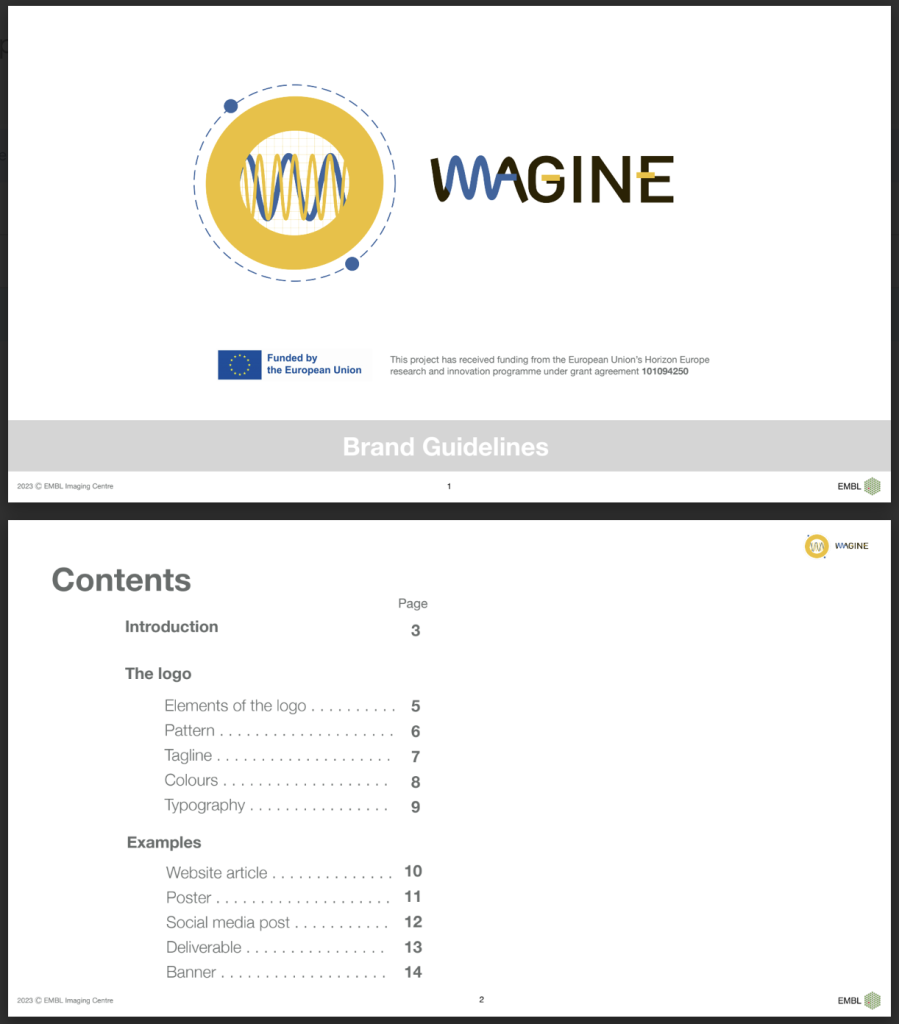
Brand Guidelines
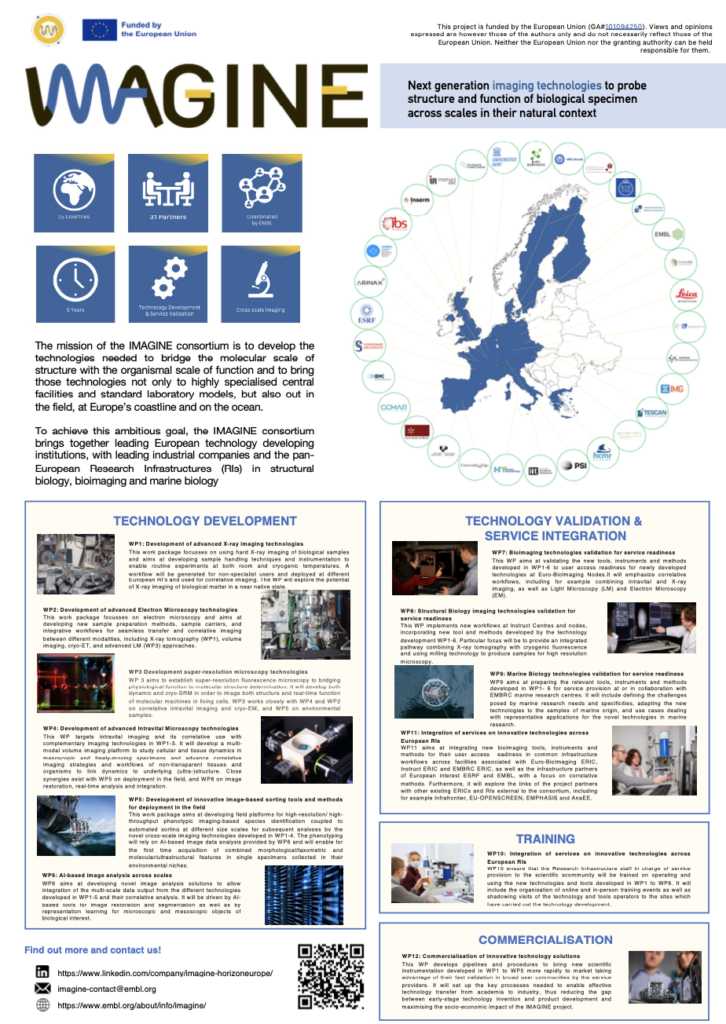
Introductory Poster