Event Highlights: 2nd EMBL Industry Day Career Panel
Post-academic industry careers in focus
The landscape of scientific careers is rapidly evolving, with industry offering increasingly diverse and rewarding roles for highly skilled researchers. To facilitate this transition and maximize the visibility of corporate opportunities, EICAT and CPP recently co-hosted EMBL’s 2nd Industry Day. The primary goal of the event was to foster collaboration between EMBL staff and companies in the research field, providing a crucial platform for educational talks, showcasing innovative technologies and products, and facilitating networking opportunities.
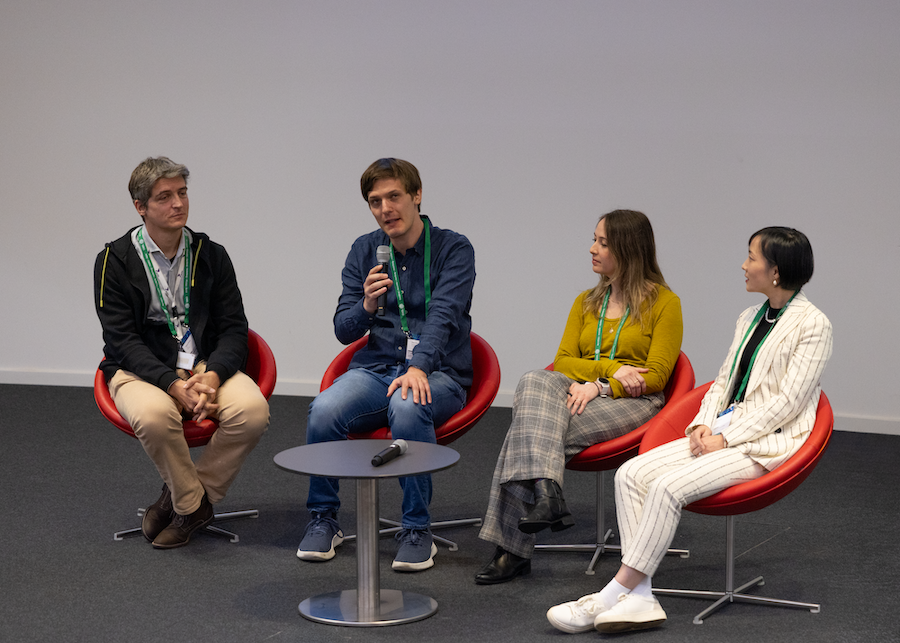
A central feature of the Industry Day was the Career Panel, which featured five representatives from participating companies. This session offered attendees an invaluable overview of roles, practical application tips, and personal insights into successful career transitions, highlighting the range of career paths available to scientists in industry.
The panel was led by Rachel Coulthard-Graf, the EMBL Fellows’ Skills and Career Development Lead, and featured a diverse group of experts:
- Shuting Xu, head of Field Application Scientist (FAS) team at GenScript
- Nayara Azevedo, Application Specialist at Roche Diagnostics
- Max Amende, AI Technical Marketing Engineer – Data Scientist at NetApp
- Robert Kirmse, Manager of Scientific Innovation at Leica Microsystems
- Sebastian Grünberg, Research Scientist at NEB
Here are the key trends, general advice, and concrete examples offered by these industry leaders for young scientists considering their move into the corporate world.
Industry Roles Beyond Laboratory Work
When scientists consider careers in industry, they often imagine continuing hands-on research in the lab – and those roles certainly exist. For example, as Sebastian Grünberg noted, NEB values “scientists doing science for scientists,” offering positions in research, product development, and production. But industry opportunities available to highly-trained researches extend well beyond core R&D laboratory work, with many opportunities at the interface of the lab and client communication. Robert Kirmse explained that at Leica Microsystems, a microscope developer and manufacturer, even though the primary focus is often on hiring physicists or optics specialists, biologists are hired to help manage contacts with clients, understand their needs, and offer training – after all, most of Leica’s clients are biologists. This demonstrates the trend that deep expertise is required to bridge the gap between technology and the end-user, even in non-R&D fields.
Applying with Potential, Not Perfection
One of the common errors made by scientists transitioning to industry is assuming they require a specific commercial background. The collective advice strongly emphasized that applicants do not need a business background to successfully secure a business-oriented job, a point emphasized by Max Amende, who stated that scientists and PhDs are often the best people to connect services and companies directly to the client. Furthermore, the panelists agreed that the focus in industry applications is fundamentally different from academia: it is crucial to demonstrate one’s potential for the future, a key distinction highlighted by Sebastian Grünberg, rather than merely cataloging currently mastered skills.
Strategies for Highlighting Relevant Experience
To create a compelling application for industry roles, young scientists should be aware that any previous industry exposure is highly valued. Shuting Xu noted that gaining even a small amount of industry experience, perhaps through a summer camp or internship, is viewed positively because it shows the applicant will be able to “speak the commercial language”. General advice encouraged strategic application: Nayara Azevedo pointed out that the job description is written for an ideal candidate, and applicants should apply even if they only meet most of the requirements. In fact, Robert Kirmse encouraged scientists not to be scared to apply even if they are not a perfect fit, stressing that a margin of not fitting – such as lacking specific marketing experience – is acceptable if the core technical requirements are met.
Networking and the Importance of the Follow-Up
Preparation and professional proactiveness are paramount in the recruitment process. Beyond initial preparation, the panelists emphasized that building a strong network early is critical, as connections can be leveraged in company referral programs. As Sebastian Grünberg pointed out, candidates are advised to thoroughly research both the role and the company prior to any interview. The Panel also agreed on the importance of a follow-up after an interview; a powerful example of proactive behavior was shared by Robert Kirmse, who stated that his very first industry role was secured precisely because he followed up after the interview. This action ensures a candidate is remembered and builds professional connections, even if the specific job is not immediately offered.
The Cover Letter: Seeking Passion Over Keywords
With the rise of AI tools, the sincerity of the cover letter was discussed. Robert Kirmse noted that he personally doesn’t look at cover letters, prioritizing the CV and core experience. However, for those applications that pass HR screening and reach the hiring manager, the cover letter serves as a crucial indicator of intrinsic motivation. Shuting Xu explained that when she reviews cover letters, she looks for genuine passion and the “ego to drive the career,” asserting that she can usually sense whether the content reflects authentic personal drive or is simply a buildup of keywords prepared by AI.
Navigating the Cultural Shift to Commercial Environments
The move from academic research to industry necessitates significant cultural and procedural adaptation. Nayara Azevedo highlighted that it takes time to understand corporate frameworks, compliance, and departmental structures – elements that are typically absent in academic research. A key structural change involves project leadership. Shuting Xu noted that during a PhD, the student is often the project leader with the power to unilaterally decide the next steps, but in industry, there is collaboration at every stage of a project, meaning the scientist is no longer running projects on their own. Furthermore, Max Amende pointed out that company type matters: in Europe, bigger companies usually offer less job flexibility but more job stability, a trade-off applicants must weigh when considering their personal priorities.
The Highly Collaborative Nature of Industry Work
The amount of time spent collaborating versus working alone varies significantly by role, but for most positions, high interaction is the norm. Shuting Xu and Nayara Azevedo both reported spending a large majority of their time (up to 90%) with people, and only 10% on solitary tasks like content creation. Conversely, roles focused on highly technical tasks, such as product testing, require less collaboration. The general trend shows that successful industry careers demand strong interpersonal skills.
Finding Professional Fulfillment and Retrospective Exploration
When asked about what they enjoy most about their current role, the panelist offered diverse answers, including engaging with technology, building new products, or staying connected to research. For Robert Kirmse, enjoyment stems from getting to work with the technology he loves (microscopes). Sebastian Grünberg noted that for him a major reward is the ability to still be a scientist, engaging in basic research and publishing papers, often at a slightly faster pace than their academic counterparts. In the final question, panelists reflected on what piece of advice they would offer to their “past academic selves”. Sebastian Grünberg offered powerful retrospective advice, saying he wished he had participated in more panel discussions like the Industry Day event, as lack of exposure often made industrial biotech feel like the “dark side”. This underscores the importance of intentionally exploring the biotech sector early to keep eyes opened to all possibilities, as further advised by Shuting Xu.
A career in industry requires a shift in mindset, much like transitioning from being an independent artisan perfecting a single craft to becoming a specialized member of a high-efficiency production team. While the depth of knowledge remains crucial, the environment shifts: one must learn to operate within a complex, highly structured vessel, where every action requires real-time collaboration and navigation of established protocols, ensuring the entire team reaches the mission objective successfully.
This content was developed with assistance from Google NotebookLM.