
Katie Bentley
The Francis Crick Institute
UK
EMBO Practical Course
Applications for this event are not open yet. If you are interested in receiving more information please register your interest.
This practical course teaches the basics of multicellular modelling to any researcher wishing to enter the field, particularly experimentalists with no prior experience of computational modelling.
It is a “hands-on” course with 60% of the time devoted to students working on laptops performing exercises designed to give a practical familiarity with different types of computational modelling. The course focuses on the dynamics of multicellular systems- from embryos to organoids, covering both the molecular side (how gene regulatory networks perform pattern formation) and also the mechanical side in 2D and 3D (how the movements and activities of many cells together leads to tissue-level morphogenesis and organisation).
A carefully-chosen variety of modelling tools will be introduced, which cover the core approaches of vertex models, finite element models (FEM), and agent-based models (ABM). Attendees will also work through the week in small groups on group projects, which will be presented on the last day to the whole class. Each day will end with a keynote lecture by a prominent researcher in the field, putting the topic of the day into context through an example of relevant biological research.
The week is organised to maximise networking between the students and the teachers and speakers.
“The Computational Modelling of Multicellular Systems course was a great introduction to theoretical frameworks and practical applications of modelling dynamic tissues. After the course, I feel much more confident to describe my experimental system in computational terms, make decisions about how to model it, and am much more connected to modelling experts to support my work in the future.” – Frea Mehta, Ludwig Maximilian University of Munich; Technical University of Munich, Germany
“This course was an absolute game changer for me! Before, I had a vague idea that I would like to do more modelling in the future. Now I am absolutely sure, that it is what I want to base my further career on.” – Mariia Golden, Philipps-University Marburg, Germany
This event has been granted the following EMBO sustainability badge:
The Francis Crick Institute
UK
Institute for Integrative Systems Biology (I²SysBio) CSIC-UV
Spain

The Francis Crick Institute
UK
University of Geneva
Switzerland

EMBL Barcelona
Spain
EMBL Barcelona
Spain
Collège de France
France
University of Oxford
UK

Purdue University
USA
The Francis Crick Institute
UK
EMBL Barcelona
Spain
EMBL Barcelona
Spain
Purdue University
USA

Project Manager – Collaboratorium
EMBL Barcelona
Spain

Course and Conference Team Lead
EMBL Heidelberg
Germany
Are you on social media? Post using #EMBOMulticellModelling and don’t forget to tag @EMBLEvents.
| Time | Description | Location |
|---|---|---|
| 14:00 – 14:30 | Welcome drink & nibbles, Meet & greet | |
| 14:30 – 15:00 | Housenotes and course overview Alejandro Torres-Sánchez – EMBL Barcelona, Spain | Collaboratorium |
| 15:00 – 16:00 | Bootcamp – Lecture 1: Introduction to modelling, and basic intro to ODEs James Sharpe – EMBL Barcelona, Spain | Seminar Room |
| 16:00 – 16:30 | Coffee break | |
| 16:30 – 18:30 | Bootcamp – Practical session 1: Introduction to Python and scientific programming Main Trainer: James Sharpe – EMBL Barcelona, Spain Software: Python code in Google Collab | Seminar Room |
| 18:30 – 21:00 | Dinner | Restaurant |
| Time | Description | Location |
|---|---|---|
| 08:55 – 09:00 | Overview of the day James Sharpe – EMBL Barcelona, Spain | Seminar Room |
| 09:00 – 10:45 | Bootcamp – Practical session 2: Solving and visualising ordinary differential equations Main trainer: James Sharpe – EMBL Barcelona, Spain Software: Python code in Google Collab | Seminar Room |
| 10:45 – 11:15 | Coffee break | |
| 11:15 – 13:00 | Bootcamp – Practical session 3: Application of ordinary differential equations to gene regulatory networks Main trainer: Zena Hadjivasiliou – The Francis Crick Institute, UK Software: Python code in Google Collab | Seminar Room |
| 13:00 – 14:00 | Lunch | |
| 14:00 – 16:15 | Bootcamp – Practical session 4: Object-oriented programming for computational biology including flexible coffee break Main trainer: Alejandro Torres-Sánchez – EMBL Barcelona, Spain Software: Python code | Seminar Room |
| 16:15 – 18:00 | Bootcamp – Practical session 5: AI-assisted scientific programming including flexible coffee break Main trainer: Alejandro Torres-Sánchez – EMBL Barcelona, Spain | Seminar Room |
| 18:00 | Free evening |
| Time | Description | Location |
|---|---|---|
| 08:55 – 09:00 | Overview of the day Zena Hadjivasiliou – The Francis Crick Institute, UK Topic of the day: Positional information, morphogen gradients, and scaling | Seminar Room |
| 09:00 – 09:45 | Lecture 2: Morphogens, positional information and pattern formation: from the French Flag model to modern developmental systems Zena Hadjivasiliou – The Francis Crick Institute, UK | Seminar Room |
| 09:45 – 10:45 | Practical session 6: Building and analysing morphogen gradients Main trainer: Zena Hadjivasiliou – The Francis Crick Institute, UK Practical exercises on laptops: – Diffusion and degradation – Steady-state gradients – Effects of source size and boundary conditions Software: Python notebook | Seminar Room |
| 10:45 – 11:15 | Coffee break | |
| 11:15 – 12:00 | Lecture 3: Scaling and robustness of developmental patterning Zena Hadjivasiliou – The Francis Crick Institute, UK | Seminar Room |
| 12:00 – 13:00 | Practical session 7: Modelling scaling in growing tissues Main trainer: Zena Hadjivasiliou – The Francis Crick Institute, UK Software: Python notebook | Seminar Room |
| 13:00 – 14:00 | Lunch | UPF Canteen |
| 14:00 – 14:45 | Lecture 4: Mechanisms of morphogen transport and interpretation Zena Hadjivasiliou – The Francis Crick Institute, UK | Seminar Room |
| 14:45 – 15:45 | Practical session 8: Exploring robustness and precision of positional information Main trainer: Zena Hadjivasiliou – The Francis Crick Institute, UK Software: Python notebook | Seminar Room |
| 15:45 – 16:15 | Coffee break | |
| 16:15 – 19:00 | Practical group projects (session 1) including flexible coffee break Main trainers: Zena Hadjivasiliou, James Sharpe, Alexandria Volkening, Javier Buceta, Alejandro Torres-Sánchez | Breakout Area |
| 19:00 – 20:00 | Keynote I: Computational tools to understand the evolution of phenotypic diversity Berta Verd – University of Oxford, UK | Seminar Room |
| 20:00 – 22:00 | Dinner | Restaurant |
| Time | Description | Location |
|---|---|---|
| 08:55 – 09:00 | Overview of the day James Sharpe – EMBL Barcelona, Spain Topic of the day: Turing mechanisms and self-organised pattern formation | Seminar Room |
| 09:00 – 09:45 | Lecture 5: Reaction-diffusion systems and Turing’s theory of pattern formation James Sharpe – EMBL Barcelona, Spain | Seminar Room |
| 09:45 – 10:45 | Practical session 9: Building activator-inhibitor systems Main trainer: James Sharpe – EMBL Barcelona, Spain Practical exercises on laptops: – Emergence of patterns – Parameter exploration Software: LimbNET | Seminar Room |
| 10:45 – 11:15 | Coffee break | |
| 11:15 – 12:00 | Lecture 6: From equations to biological patterns: analysing Turing mechanisms James Sharpe – EMBL Barcelona, Spain | Seminar Room |
| 12:00 – 13:00 | Practical session 10: Pattern formation in developmental systems Main trainer: James Sharpe – EMBL Barcelona, Spain Practical exercises on laptops: – Digit patterning – Feather patterning – Pigmentation – Comparing competing mechanisms Software: LimbNET | Seminar Room |
| 13:00 – 14:00 | Lunch | UPF Canteen |
| 14:00 – 14:45 | Lecture 7: Combining positional information and self-organisation. Examples from vertebrate limb development James Sharpe – EMBL Barcelona, Spain | Seminar Room |
| 14:45 – 15:45 | Practical session 11: Pattern formation in vertebrate limb development Integrating positional information with self-organisation Main trainer: James Sharpe – EMBL Barcelona, Spain Practical exercises on laptops: – Gradients controlling self-organisation – Self-organisation controlling positional information Software: LimbNET | Seminar Room |
| 15:45 – 16:15 | Coffee break | |
| 16:15 – 19:00 | Practical group projects (session 2) including flexible coffee break Main trainers: Zena Hadjivasiliou, James Sharpe, Alexandria Volkening, Javier Buceta, Alejandro Torres-Sánchez | Breakout Area |
| 19:00 – 20:00 | Keynote II: The unreasonable effectiveness of reaction-diffusion in vertebrate skin patterning Michel Milinkovitch – University of Geneva, Switzerland | Seminar Room |
| 20:00 – 22:00 | Dinner | Restaurant |
| Time | Description | Location |
|---|---|---|
| 08:55 – 09:00 | Overview of the day Alexandria Volkening – Purdue University, USA Topic of the day: Agent-based Modelling of complex tissues | Seminar Room |
| 09:00 – 09:45 | Lecture 8: Introduction to agent-based modeling with flocking and swarming Alexandria Volkening – Purdue University, USA | Seminar Room |
| 09:45 – 10:45 | Practical session 12: Introduction to agent-based modelling. Collective behaviour, flocking and swarming. Main trainer: Alexandria Volkening – Purdue University, USA Software: Python code in Google Collab | Seminar Room |
| 10:45 – 11:15 | Coffee break | |
| 11:15 – 12:00 | Lecture 9: Modelling pattern formation in an agent-based model, diffusion, gene regulation networks, and feedback on morphogenesis Alexandria Volkening – Purdue University, USA | Seminar Room |
| 12:00 – 13:00 | Practical session 13: Pattern formation using interacting agents Diffusion, signalling and feedback during tissue development Main trainer: Alexandria Volkening – Purdue University, USA Software: Python code in Google Collab | Seminar Room |
| 13:00 – 14:00 | Lunch | UPF Canteen |
| 14:00 – 14:45 | Lecture 10: Modelling complex tissues – stripe formation in zebrafish Alexandria Volkening – Purdue University, USA | Seminar Room |
| 14:45 – 15:45 | Practical session 14: Modelling multicellular systems – zebrafish stripe formation Main trainer: Alexandria Volkening – Purdue University, USA Software: Python code in Google Collab | Seminar Room |
| 15:45 – 16:15 | Coffee break | |
| 16:15 – 18:15 | Flash talks | Breakout Area |
| 18:15 – 19:00 | Networking and Meet the speakers | Breakout Area |
| 19:00 – 20:00 | Keynote III: Using Agent-based Models to explain vasculogenesis Katie Bentley – Francis Crick Institute, UK | Seminar Room |
| 20:00 – 22:00 | Dinner | Restaurant |
| Time | Description | Location |
|---|---|---|
| 08:55 – 09:00 | Overview of the day Javier Buceta – I²SysBio, CSIC-UV, Spain Topic of the day: 2D vertex models of epithelia | Seminar Room |
| 09:00 – 09:45 | Lecture 11: An Overview of Tissue Simulation Schemes: Spins, Giraffes, Vertexes, Scutoids and all that Zoo (I) Javier Buceta – I²SysBio, CSIC-UV, Spain | Seminar Room |
| 09:45 – 10:45 | Practical session 15: Introduction to vertex models Main trainer: Javier Buceta – I²SysBio, CSIC-UV, Spain Software: TiFoSi on a Docker image | Seminar Room |
| 10:45 – 11:15 | Coffee break | |
| 11:15 – 12:00 | Lecture 12: An Overview of Tissue Simulation Schemes: Spins, Giraffes, Vertexes, Scutoids and all that Zoo (II) Javier Buceta – I²SysBio, CSIC-UV, Spain | Seminar Room |
| 12:00 – 13:00 | Practical session 16: Tissue remodelling and epithelial mechanics Main trainer: Javier Buceta – I²SysBio, CSIC-UV, Spain Software: TiFoSi on a Docker image | Seminar Room |
| 13:00 – 14:00 | Lunch | UPF Canteen |
| 14:00 – 14:45 | Lecture 13: Boundaries and Patterning Javier Buceta – I²SysBio, CSIC-UV, Spain | Seminar Room |
| 14:45 – 15:45 | Practical session 17: Patterning and morphogenesis in epithelial tissues Main trainer: Javier Buceta – I²SysBio, CSIC-UV, Spain Software: TiFoSi on a Docker image | Seminar Room |
| 15:45 – 16:15 | Coffee break | |
| 16:15 – 18:15 | Practical group projects (session 3) including flexible coffee break Main trainers: Zena Hadjivasiliou, James Sharpe, Alexandria Volkening, Javier Buceta, Alejandro Torres-Sánchez | Breakout Area |
| 18:15 – 19:00 | Keynote IV: Learning tissue mechanics from geometry: vertex models, force inference and inverse morphogenesis Hervé Turlier – Collège de France, France | Seminar Room |
| 19:00 | Free evening |
| Time | Description | Location |
|---|---|---|
| 08:55 – 09:00 | Overview of the day Alejandro Torres-Sánchez (EMBL Barcelona, Spain) Topic of the day: Continuum models of tissue mechanics | |
| 09:00 – 09:45 | Lecture 14: An introduction to rheology and the rheology of tissues Alejandro Torres-Sánchez – EMBL Barcelona, Spain | Seminar Room |
| 09:45 – 10:45 | Practical session 18: The rheology of an ensemble of dynamic linkers: the Lacker-Peskin model. Main trainer: Alejandro Torres-Sánchez – EMBL Barcelona, Spain Software: Python script in a Docker image | Seminar Room |
| 10:45 – 11:15 | Coffee break | |
| 11:15 – 12:00 | Lecture 15: An introduction to continuum mechanics & linear elasticity. Alejandro Torres-Sánchez – EMBL Barcelona, Spain | Seminar Room |
| 12:00 – 13:00 | Practical session 19: Finite element method applied to linear elasticity. Laser ablations to test tissue mechanics. Main trainer: Alejandro Torres-Sánchez – EMBL Barcelona, Spain Software: hiperpy in a Docker image | Seminar Room |
| 13:00 – 14:00 | Lunch | UPF Canteen |
| 14:00 – 14:45 | Lecture 3: Physics-informed AI for mechanistic modelling Alejandro Torres-Sánchez – EMBL Barcelona, Spain | Seminar Room |
| 14:45 – 15:45 | Practical session 20: Physics-informed neural networks for inverse problems Main trainer: Alejandro Torres-Sánchez – EMBL Barcelona, Spain Practical exercises on laptops: – Estimating unknown material parameters from simulated data – Comparing classical optimisation with PINNs – Incorporating physical constraints into machine learning Software: Python notebook & pytorch | Seminar Room |
| 15:45 – 16:30 | Coffee break | |
| 16:30 – 18:30 | Group project presentations including flexible coffee break | Seminar Room |
| 18:30 – 19:30 | Wrap up discussion and course debrief – compare and contrast the different modelling approaches and discuss the criteria and underlying assumptions to help choose which approach is appropriate for which biological question – discuss resources and advice on how to go forward with your own computational modelling research | |
| 19:30 – 21:30 | Dinner | Restaurant |
The course is limited to 20 participants. For selection purposes, please note that your application will not be considered without a letter of motivation.
Your registration for the event includes:
| Academia | €550 |
| PhD Student | €550 |
| Industry | €1000 |
The registration fee should be paid only after acceptance to the course. The results will be announced approximately 2-3 weeks after the application deadline.
If you are no longer able to take part in the course, please inform your course contact responsible for this event. Your registration and the submitted motivation letter will be deleted.
Please also check our Terms and Conditions for the cancellation policy.
After you have logged in and successfully registered, you will receive an email asking you to submit your motivation letter. Click on the link provided and enter your motivation letter in the text box provided. Alternatively you can submit your motivation letter by clicking on the link on the confirmation page directly after registering.
Instructions
Please note:
For detailed instructions, please watch our video on how to submit a course motivation letter.
Please note it is not possible to apply after the motivation letter deadline!
The selection results will be announced by email to all applicants. We aim to announce 3 weeks (21 days) after the motivation letter submission deadline but delays may occur.
For further information about registration and motivation letter submission please refer to the FAQ page.
Limited financial assistance is provided by the EMBL Advanced Training Centre Corporate Partnership Programme and EMBO in the form of travel grants, childcare grants, and accessibility grants.
Your place in the meeting is only confirmed by paying the registration fee, which is mandatory even when receiving a fee waiver.
The travel grant will cover the cost of travel (airfare, train, bus, taxi, and visa) and/or registration fees and is provided up to specified caps which are normally as follows:
The organisers may reduce the grant cap to accommodate more participants. Recipients will be notified of their travel cap amount when they are informed of the outcome of their application. Receipts must be provided via email with your signature for all costs incurred within two months of completion of travel.
There is the possibility to apply for a childcare grant to offset child care costs incurred by participants, speakers, trainers, and organisers when attending a course. Eligible costs include (but are not limited to) fees for a babysitter, child-care facility, or travel costs for a caregiver. Please note that priority will be given to early-stage researchers. There is a limited amount of funding available for the childcare grants and funds will be distributed amongst eligible applicants.
Applies to selected courses only. Availability will be indicated during the abstract or motivation letter submission process.
This grant covers costs related to your attendance to the course (registration, travel, and accommodation costs). The grant is restricted to PhD students and postdocs who conduct basic biomedical research.
Whether you are eligible to apply for a travel grant, depends on when you received your university entrance qualification (e.g. Abitur, A-Levels, High School Diploma, Final State Examination):
Applies to selected courses only. Availability will be indicated during the abstract submission process.
The EFU fellowship covers full costs related to your attendance at the course (registration fee, travel and accommodation costs). The grant is restricted to supporting academic or clinical PhD students and postdoctoral researchers whose primary research areas maybe on cancers broadly, but must especially demonstrate in the course motivation letter clear relatability or knowledge transferability to urological cancers (prostate, bladder, kidney, testicular, penile, and urethral cancers).
To qualify for the EFU fellowship, applicants are required to include a brief statement in their motivation letter explaining how this is evident.
The scope of the full grant includes the following:
The funded participants are required to submit a personal curriculum vitae, as well as a letter of recommendation from their host institution or laboratory. In addition, awardees must provide a short report within 30 days after the course completion, describing how their participation benefited them and contributed to the advancement of their research (up to 2,000 characters).
For EMBO Practical Course participants with accessibility needs, there is the possibility to apply for an accessibility grant to offset costs incurred by participants or speakers when participating at a course. Eligible costs include costs incurred for equipment or adaptations to the course environment, or travel costs for an event companion to assist the participant or speaker during the course where necessary. While we do our best to accommodate needs, please note that extensive changes to the course environment might not be possible. Priority will be given to early-stage researchers.
A maximum amount of €500 can be awarded per participant applying for an EMBO accessibility grant. In order to apply for this grant for EMBO Practical Courses, you must be registered by the application deadline.
You may apply for financial assistance when submitting your motivation letter. In the application system, you will be asked which type of grant you want to apply for.
Applications for financial support will not influence the outcome of the selection results.
Grant allocations are announced by email to all applicants after the selection results.
Selection for financial assistance is based on scientific merit, your current work or study location, the reasons for needing financial support, and the impact this event will have on your career.
Please note that for childcare grants, priority will be given to early-stage researchers.
Check out this list of external funding opportunities.
For further information about financial assistance please refer to the FAQ page.
We can send you a registration confirmation to support your visa procedure (not an official invitation letter). Please contact the Conference Officer responsible for your event. Read our FAQ for more information.
Accommodation has been pre-booked for you at a nearby hotel for the default dates of 12 June to 19 June 2027 (7 nights). Please note that the course registration fee includes coverage of accommodation costs in twin rooms, including breakfast. The address will be communicated later in the process.
The hotel is just a few minutes from the Collaboratorium space where the practical course will be held.
For more information about accommodation and travel, please refer to the FAQ page.
The EMBL eCampus learning platform will be used to collaborate, communicate and network with all of the course participants. All participants will receive information on how to join shortly before the course. We recommend using Chrome, Safari or Mozilla Firefox browsers for eCampus.
Sponsorship opportunities
We offer a variety of event sponsoring possibilities, with the flexibility to select a set sponsorship package or combine individual sponsorship options to suit your event budget. Discounts are available for companies sponsoring multiple events at EMBL Heidelberg. View other conferences, or contact sponsorship@embl.org. for further information.
If you are interested in becoming a media partner of this event, please visit our media partnerships webpage.
EMBL wishes to warn sponsors of EMBL conferences and courses of fraudulent schemes purporting to offer sponsorship opportunities on behalf of EMBL or affiliated with EMBL officials. One current scam campaign of which we are aware is conducted using the name ‘Judy Eastman’ (judy@gopcontact.a2hosted.com) and entails approaches to sponsors offering sponsorship opportunities on EMBL’s behalf. Please be kindly advised that all relevant communication regarding sponsorship of EMBL conferences, symposia and courses is handled by EMBL directly and is sent from an official EMBL account. EMBL does not work with any external providers on sponsorship acquisition.
Please also note that:
Suspicious communications purportedly from, for or on behalf of EMBL should be reported to EMBL at the following email address sponsoring@embl.de.
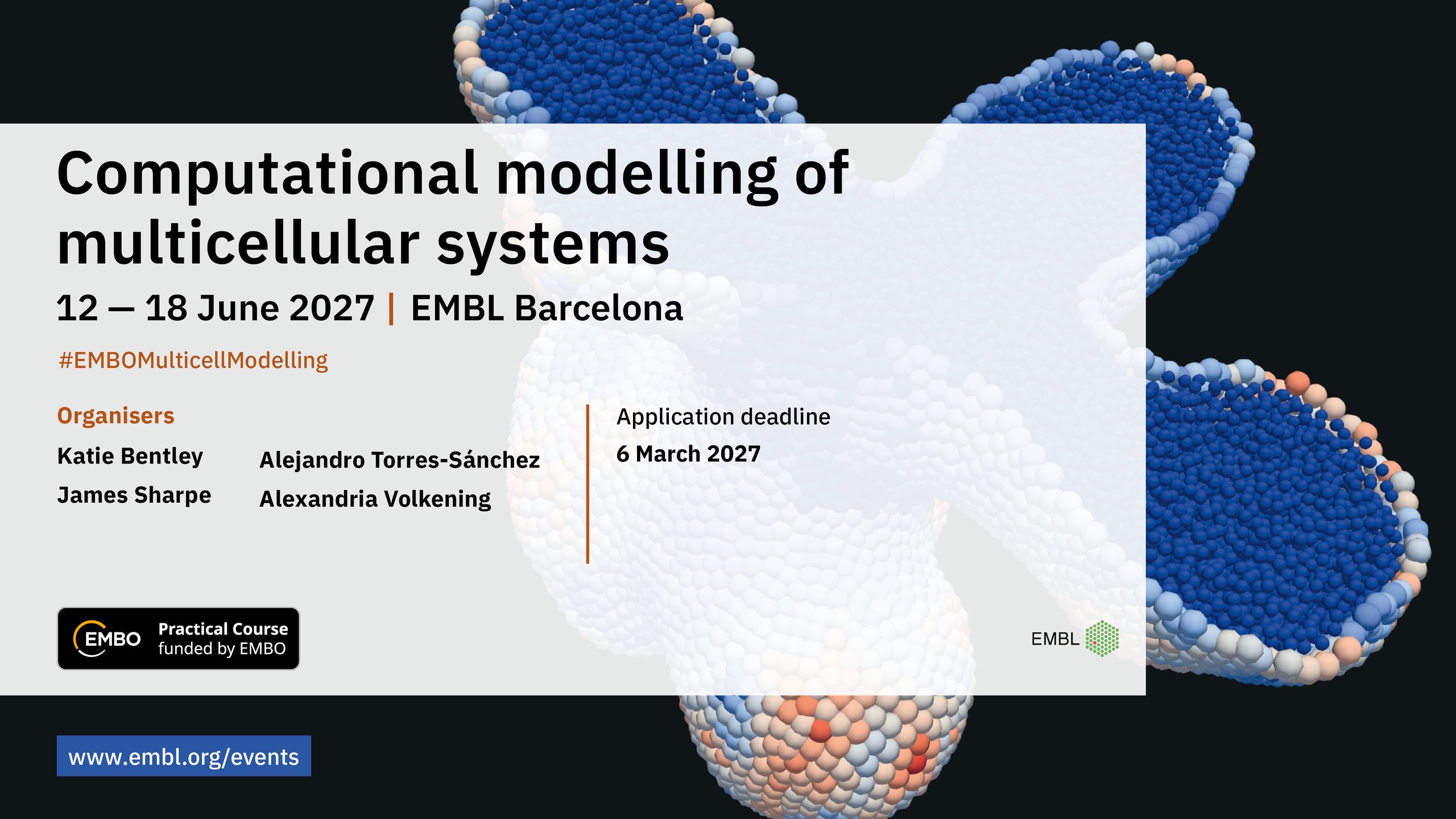
Want to let others know you’re attending this event? Take a look at our shareable media and feel free to use them in your social media channels or presentations.

Date: 12 - 18 Jun 2027
Location: EMBL Barcelona
Venue: Barcelona Collaboratorium for Modelling and Predictive Biology
Organisers:
Contact: Iva Gavran
Download event poster
empty