The EMBL Archive 2025 Round-up.
Over the course of this year we’ve published a lot of articles about everything from Grenoble’s history as a scientific hub to the first synchrotron diffraction experiment conducted at EMBL Hamburg. Today we’d like to stick closer to home and talk about what we’ve been up to in the archive in 2025. We’ve been in post as the new Archive and Records Managers since February, and it’s been a busy year for us!
It was crucial for us to take advantage of the momentum created by our predecessor for the 50th anniversary of EMBL, and so a lot of our efforts revolved around community building.
Grenoble
In the summer we traveled to Grenoble for their anniversary celebrations. We were able to complete a high-level inventory of their storage rooms and hope to work with them on freeing up some of that space by both disposing of some obsolete materials and bringing some exciting stuff back to the archive! We also presented our work and remit to some of the staff at the site, and were lucky enough to interview group leaders Josan Marquez, Andrew McCarthy, and Gergely Papp about their work. Finally we were delighted to take part in the anniversary celebrations where we presented a small exhibition of archival material related to EMBL Grenoble, watched all the presentations from staff past and present, and enjoyed a canapé or two.
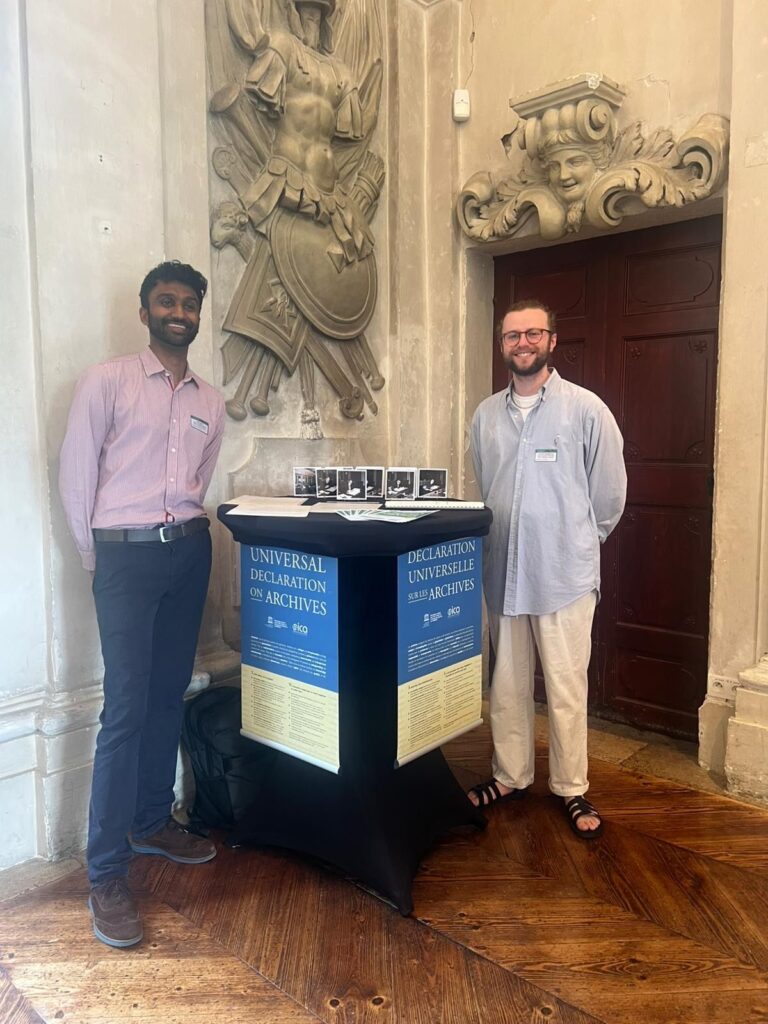
2025 saw the retirement of Rolf Apweiler, now Visitor Emeritus at EMBL-EBI, after a long career in which he made major contributions to automatic protein annotation and served as Joint Director from 2015 to 2024. His retirement gave us a good opportunity to visit the EBI site, look through his papers and do an initial, high-level review of the situation around records management.
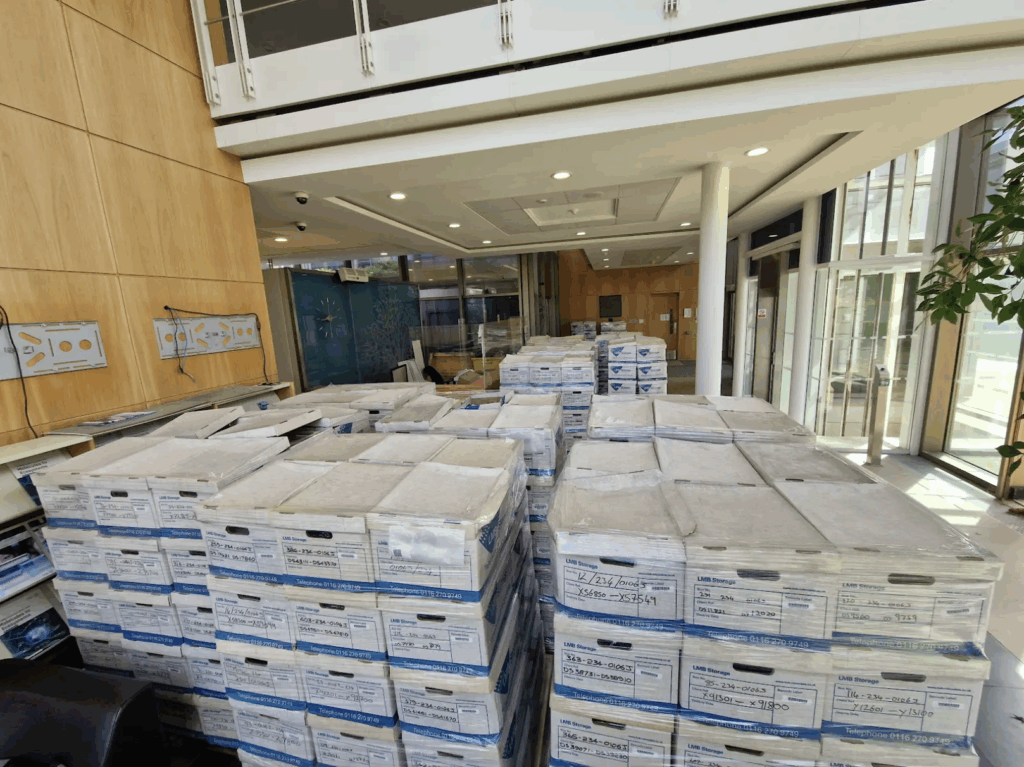
Our main task was to understand what the roughly 400 boxes stored off-site actually contained. We had a general sense that they held sequence submission material, but this was based on a small sample from years ago and there was no accurate inventory. We needed to be sure of what we had before deciding on next steps. Andrew C from EBI was invaluable in arranging the logistics. In total we reviewed 438 boxes over the course of a week. Luckily, the metadata written on the boxes matched their contents, so it became a straightforward process of noting key details: what each box held, the date range and its location.
The boxes contained nucleic acid and protein sequence submission forms from 1983 to 2001, showing how this work was handled in the early years. All submissions and data are searchable through the EBI site. The next stage is to decide what should come into the archive and what can be disposed of.
Records Management
After a period of slower progress in records management at EMBL, this year has been about rebuilding a clear direction. We started by reviewing earlier work and identifying the areas most in need of attention. Together with the Data Protection office, we prepared a short summary of the current landscape and shared it internally. We also refreshed the 2019 retention schedule material to make it easier to navigate and uploaded it to the records management intranet page.
To understand current practices, we carried out exploratory visits across departments and sites. A major finding was the need for an EMBL-wide retention schedule, so planning for a project to develop one has been a key focus in the latter part of the year. We expect to launch this work early next year and invite colleagues who are interested to get involved.
Archive coffee hour
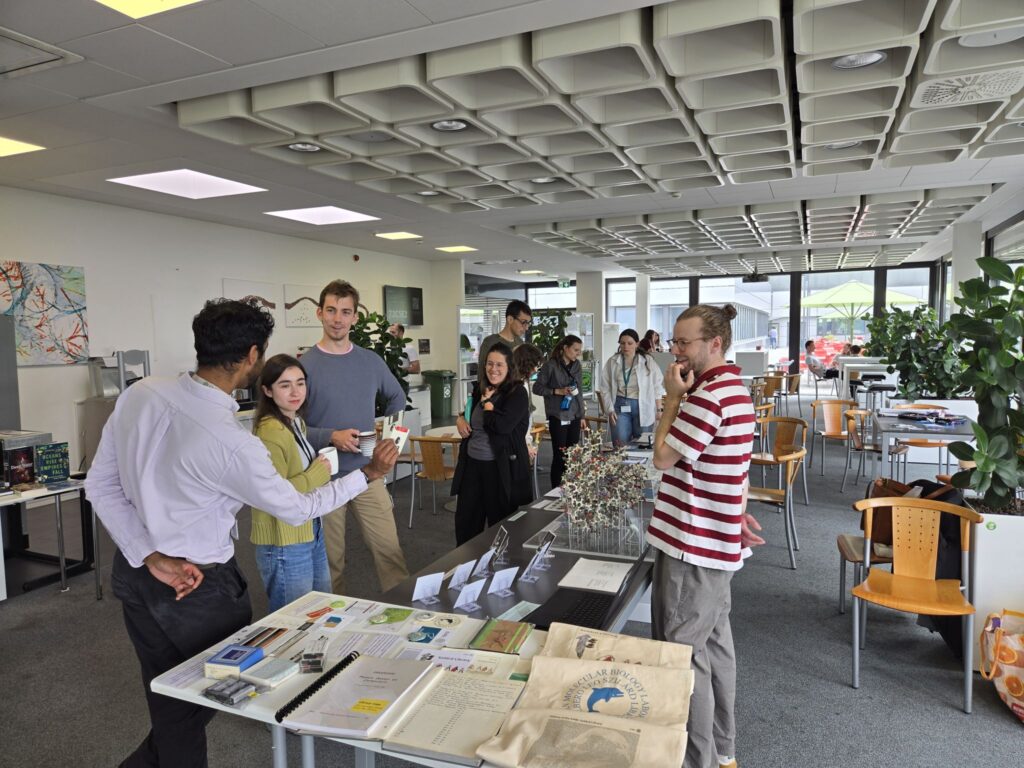
This push for community engagement and raising the profile of the Archive extended to our coffee hour event which we held in June in the EMBL cafeteria. We put together a mini-exhibition of a wide variety of objects which encapsulate our collection, including Jacques Dubochet’s Nobel Prize medal, and then invited EMBL staff to talk about our work, and also to test their knowledge of EMBL’s history with a quiz! We had a lot of productive discussions and received some great questions and feedback about our work.
Laboratory notebooks
Another aspect of EMBL’s remit is the archiving of laboratory notebooks. In 2024 the former archivist conducted a survey of EMBL’s scientific groups and received a feedback rate of 50%. On the basis of this survey and other work on the project we’ve finalised a standard operating procedure for the archiving of both physical and electronic laboratory notebooks. For the former we’ve established contact points at each site who can facilitate the transfer of labbooks to the archive, and developed a sticker and smart sheet system to ensure that all laboratory notebooks are documented in a structured, searchable database. For the latter we’re establishing workflows for the most used electronic labbook platforms and will provide guidance for scientists using others. We’re hoping to roll out the new procedures in the spring of 2026.
The Future
Whilst we managed to visit EBI-Hinxton and Grenoble, we want to visit all the sites as Archives and Records Management is for all of EMBL. We have a visit to Hamburg planned for February and will be looking to get to the other sites next year as well. Additionally, we have big plans for the future. Over the next few years we’d like to process our backlog of material, expand our collection and develop a digital preservation strategy. We’d also like to meet the desire from the EMBL community to create a more formalised records management framework and incorporate it into EMBL’s culture. This will involve creating guidance and tools to support records management and carrying out advocacy work across the six sites.
Thanks so much for following our journey over our first year. We’ve listed a few of our favourite finds from the EMBL archive below, and as always: if you want to secure your EMBL legacy, please contact us here. See you in 2026!
The Archivists’ Favourite Finds:
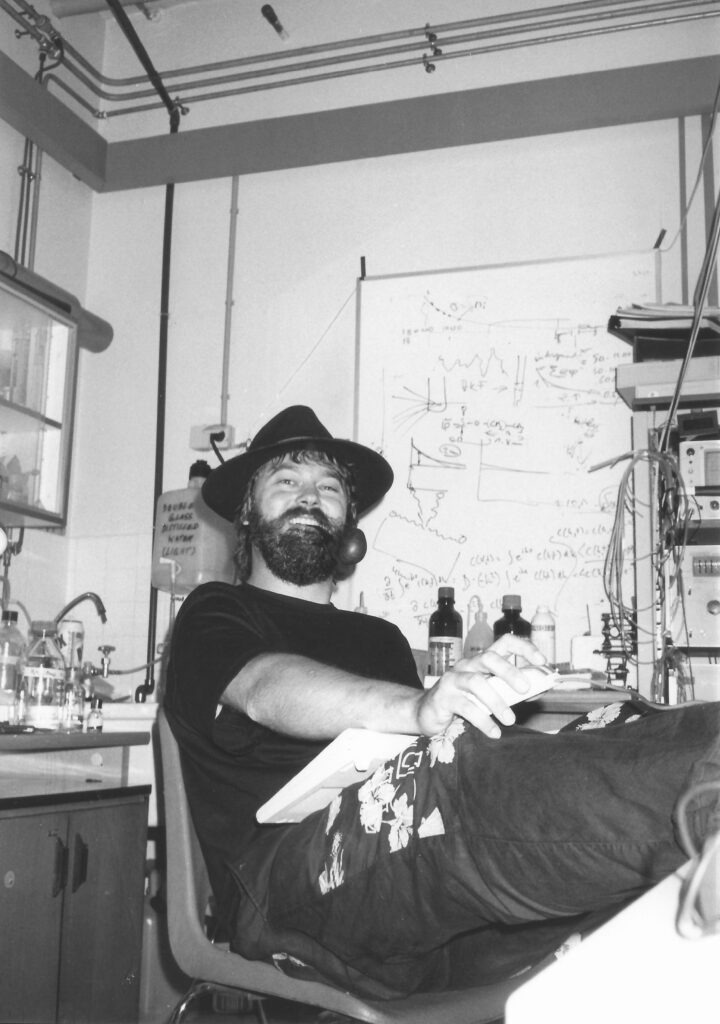
We wrote an article about the Jörg Langowski photographs earlier this year. Full of character and colour, they highlight both of the scientific and social aspects of life at EMBL perfectly. The photos can be found on the archive website here: https://archive.embl.org/index.php/jorg-langowski-photographs