Bioinformatics research
Researchers at EMBL-EBI make sense of vast, complex biological datasets produced using new and emerging technologies in molecular biology.
Understanding how cells work and how they are organised
The basic unit of all life on Earth is the cell. Cells allow chemical reactions to happen in a controlled environment, and genomic information to be safely stored, accessed, and passed on to the next generation.
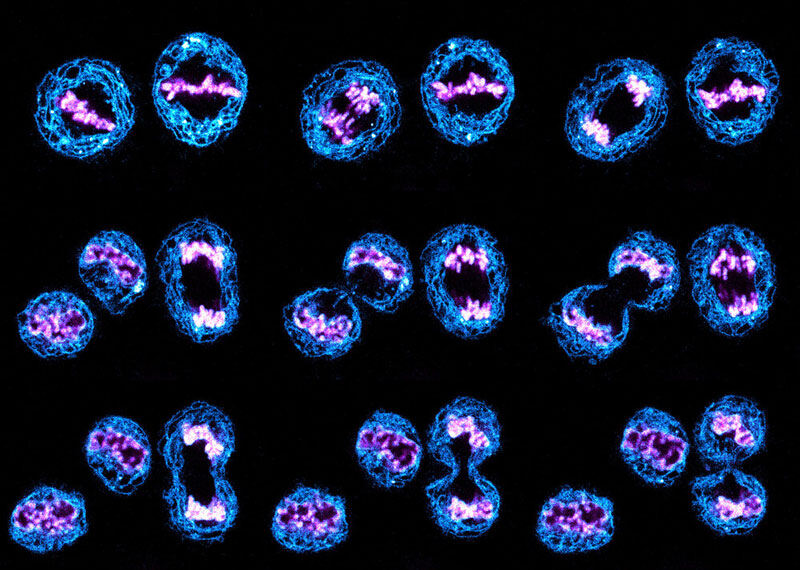
In multicellular organisms, cells differentiate into various types and form tissues and organs carrying out specific functions. Evolution has come up with an incredible variety of cell types. Cells have evolved elaborate signalling mechanisms for transmitting information, and safety mechanisms to protect the organism against external threats and internal damage. Some of the main goals of cell biology are to understand these functions, the structures and processes within cells, and the dynamic interactions between cells.
Across all EMBL sites, researchers investigate cellular processes at various scales. One focus is the processes by which cells organise their genomes within the spatial limitations of the nucleus. Another is understanding how mechanical and chemical cues combine to influence cell shapes and functions. EMBL researchers also study cell differentiation – the process during which a cell develops into another cell type with a different function, usually becoming more specialised.
Cell biology research is becoming increasingly multidisciplinary, and EMBL’s organisational structure helps to facilitate interactions between researchers with a diverse range of expertise. Cell biology integrates bioinformatic simulations and predictive modelling approaches. Systems biology helps scientists to obtain a detailed picture of cellular activity by combining measurements of gene expression, protein levels, signalling activities, and more. Advances in imaging technology permit more detailed views of cells and their components. These multidisciplinary approaches allow EMBL researchers to better understand the complex interplay of processes taking place inside a cell.
Researchers at EMBL-EBI make sense of vast, complex biological datasets produced using new and emerging technologies in molecular biology.
Scientists in this unit use multidisciplinary approaches to investigate the molecular and biophysical mechanisms that enable cells to function.
Scientists in the Developmental biology unit seek to understand the fundamental principles that govern multicellular development.
This unit covers thematically distinct research groups, headed by EMBL and EMBO leadership.
At EMBL Rome, scientists explore the connections between genome, environment, and neural function.
The Genome biology unit uses and develops cutting-edge methods to study how the information in our genome is regulated, processed, and utilised, and how its alteration leads to disease.
Scientists in this unit use integrated structural and computational techniques to study biology at scales from molecular structures to organismal communities.
At its sites in Hamburg and Grenoble, EMBL provides its researchers and hundreds of external users each year with access to world-leading sources of X-ray and neutron radiation, enabling them to study the structures of biological molecules.
Scientists at EMBL Barcelona use advanced technologies to observe, manipulate, and model how changes in genes percolate through cells, tissues, and organs, in health and disease.
Research news from EMBL’s six sites

Here are seven key takeaways from an EMBL | EMBO conference that brought together scientists from all over the world to discuss the role of AI in the life sciences.
Edit
Former EMBL group leader returns to lead the organisation’s six sites at a time of change and opportunity in life sciences.
Edit
MGnify Genomes offers new ways to explore microbial communities in soil, marine sediments, and the gut.
EditThe research group of Oliver Stegle looks for a postdoctoral researcher to join a collaborative project with GSK with the goal to apply computational methods to investigate the effects of rare variants on human traits and single-cell readouts. Our research group is pioneering computational methods...
Closes on 1st May. Posted 30th March 2026
EditJoin the Molecular Networks team at EMBL-EBI and help build the next generation of biological knowledge resources used by researchers worldwide. Our team develops and operates internationally recognised data resources including IntAct and Complex Portal, which provide expertly curated information on...
Closes on 13th April. Posted 27th March 2026
EditFrom microscopy to mycology, from development to disease modelling, EMBL researchers cover a wide range of topics in the biological sciences.