Quick take summary
Open science thrives through a blend of open-source tools, robust infrastructure, and most importantly, strong, inclusive communities.
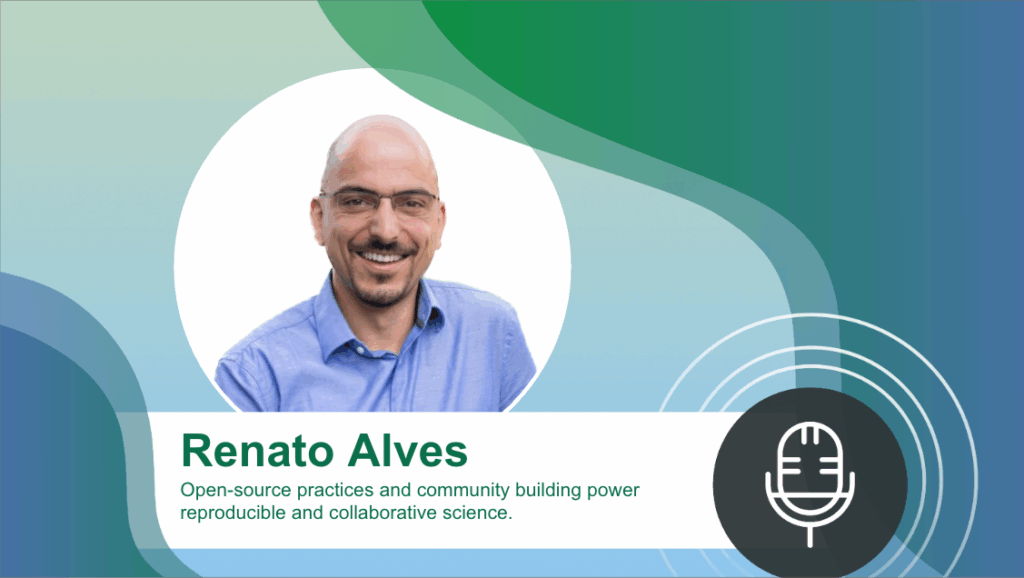
Renato Alves shares his journey from biology to bioinformatics and community management, highlighting how collaboration, mentorship, and kindness lower barriers, improve reproducibility, and connect lab work with data and code.
The key takeaway is that sustaining open science requires investing not just in technology, but in people, communication spaces, and roles that empower others to participate openly and confidently.
Challenge 2
Many researchers face practical barriers to open and reproducible science, such as complex tools, poor documentation, and high technical overhead.Solution 2
Introducing tools progressively, using clear storytelling, simple language, and beginner-friendly workflows lowers friction and helps researchers focus on solving scientific problems rather than technical obstacles.Challenge 3
Solution 3
Helpful Resources
Helpful Resources
- Open-source software and communities, including Linux and the broader open-source ecosystem
- Python (and its community), highlighted as an accessible and well-supported programming language
- IRC (Internet Relay Chat) as an early, low-barrier platform for open, global technical learning and collaboration
- Google Summer of Code, as an example of structured open-source mentorship and contribution
- Open Life Science (OLS), supporting training and mentoring around open science practices
- Stack Overflow and Q&A-style forums, referenced as part of the evolving support ecosystem for developers and scientists
- Workflow management systems to improve reproducibility and scalability of data analysis
EMBL Resources
- EMBL GitLab for code sharing, version control, and issue tracking
- EMBL chat and coding clubs at EMBL, used to lower barriers, connect experts, and support community learning
- BioIT and training infrastructure at EMBL, providing coordinated support for data, software, and open science culture
Transcript
About Renato Alves
Dr. Renato Alves is the Senior Bioinformatics Community Manager at EMBL, where he supports training, infrastructure, communities, and building collaborations as a member of EMBL’s Data Science Center. Renato is a trained biologist and bioinformatician whose career spans open-source software development, computational biology, and community building within life sciences.
Interested in speaking on The Knowledge Catalyst?
Please contact Victoria Yan: osim@embl.de
Listen to this episode on your favourite streaming platforms
Credits
Production: Victoria Yan, Anandhi Iyappan
Audio Technician and Editing: Sergio Alcaide, Felix Fischer
Original music: Sergio Alcaide, Felix Fischer
Graphics: Holly Joynes
Web Design: Victoria Yan, Szymon Kasprzyk
Photography: Kinga Lubowiecka