Before you submit your fellowship application: Five things to know
As part of our ongoing commitment to supporting researchers in their career development, we hosted a Fellowship Q&A session in February 2026 featuring EMBL fellows Andrew Michael Hogan, recipient of a Marie Skłodowska-Curie Actions (MSCA) Fellowship, Karin Prummel, an EMBO Fellow, and David Vanneste from the EMBL Grants Office. Drawing on their experiences as successful fellowship recipients and research funding professionals, the discussion explored what makes a strong fellowship application and how researchers can navigate an increasingly competitive funding landscape.
Below are five key questions that emerged from the session and the practical advice shared by the panelists. These are also incorporated in our fellowship application checklist.
When should I start preparing a fellowship application?
Much earlier than you think.
One of the strongest messages from the session was that successful fellowship applications are rarely developed in a few weeks. Researchers should begin exploring funding opportunities, eligibility criteria, and potential project ideas several months before a deadline.
Developing a project with a future host lab, identifying collaborators, understanding a new research area, and collecting feedback all take time. In some cases, fellowship planning may even begin before a postdoctoral position is formally secured.
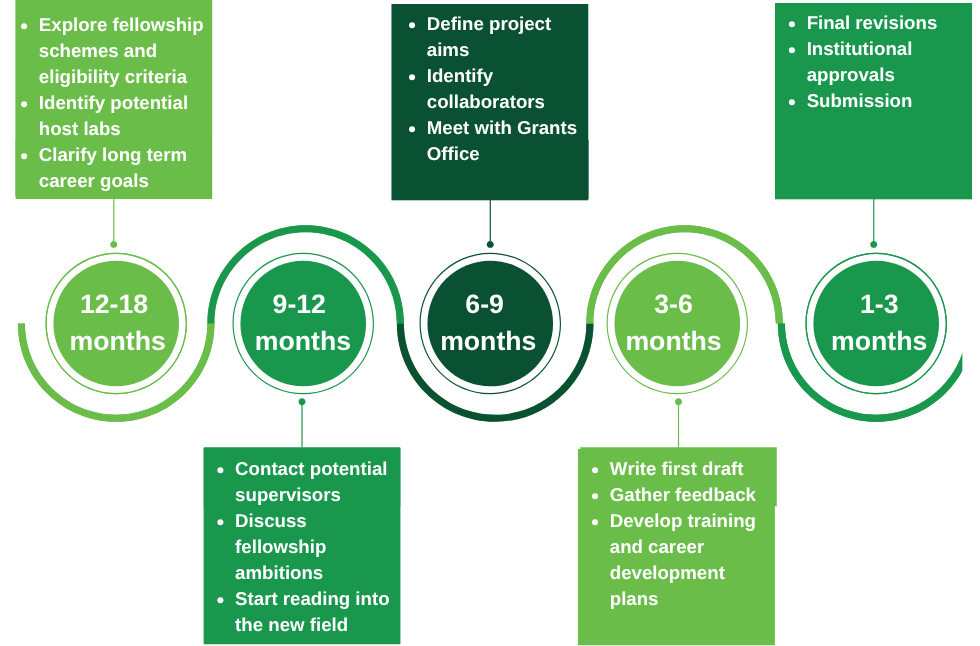
Suggested timeline highlighting the key milestones in fellowship application preparation, based on advice from fellowship awardees and funding experts.
What are reviewers actually looking for
Reviewers are evaluating much more than the science.
A strong fellowship application demonstrates scientific excellence, but it also shows why the applicant is the right person to carry out the project, how the host environment will support their development, and what impact the fellowship will have on their future career.
The panel emphasised that applicants should clearly explain:
- What is novel about the project
- Why the research is important
- What skills they will gain
- How they will contribute to the host institution
- Why they are uniquely positioned to deliver the work
Reviewers should never be left to make these connections themselves.
How important is the host institution?
Extremely important.
Fellowship applications are not only an assessment of a project; they are also an assessment of the research environment in which that project will take place. Applicants should demonstrate a clear rationale for selecting their host institution, explain what training and expertise they will gain, and show how the collaboration creates value for both parties.
As discussed during the session, successful applications often present a compelling case for two-way knowledge transfer rather than focusing solely on what the applicant hopes to learn.
How should I use AI when writing a fellowship application?
Use it as a tool, not as a substitute for scientific thinking.
The panel acknowledged that AI tools can help improve readability, structure, and clarity. However, applicants should remain fully responsible for the scientific content and be able to defend every aspect of the proposal. A useful rule of thumb emerged from the discussion: if you cannot confidently explain an idea during an interview, it probably should not appear in your application.
Originality, critical thinking, and ownership of ideas remain essential, regardless of how the proposal is drafted.
What is the most common mistake applicants make?
Underestimating the amount of preparation required.
Successful fellowship applications typically go through multiple rounds of revision and feedback. They require careful attention to funder requirements, realistic project planning, clear writing, and strong alignment between the applicant, the project, and the host institution.
The panelists encouraged researchers to seek feedback from colleagues, supervisors, collaborators, and grant professionals early in the process. They also highlighted the importance of explicitly addressing evaluation criteria rather than assuming reviewers will infer key information from a CV or project description.
Final thought
Perhaps the most important takeaway from the session was that a fellowship application is not simply a request for funding. It is an opportunity to define a research vision, articulate career goals, build collaborations, and demonstrate scientific independence.
Whether an application is successful or not, the process itself can be an invaluable step in a researcher’s professional development.