Celebrate our 50th anniversary!
The European Molecular Biology Laboratory is a powerhouse of biological expertise.
With 29 support from more than 30 countries, EMBL is looking forward to celebrating its 50 years of impactful science that has come from the more than 110 independent research groups and service teams covering the spectrum of molecular biology at our six sites in Barcelona, Grenoble, Hamburg, Heidelberg, EMBL-EBI Hinxton, and Rome.
Join us in observing EMBL’s 50th anniversary by sharing EMBL with your networks. Browse below for quick and effective ways to do this.

Add EMBL to your email signature
Copy and paste one of the text lines below to incorporate into your e-mail signature. The text lines include a link to the EMBL 50th anniversary home page, for your convenience:
Download and display EMBL wallpapers
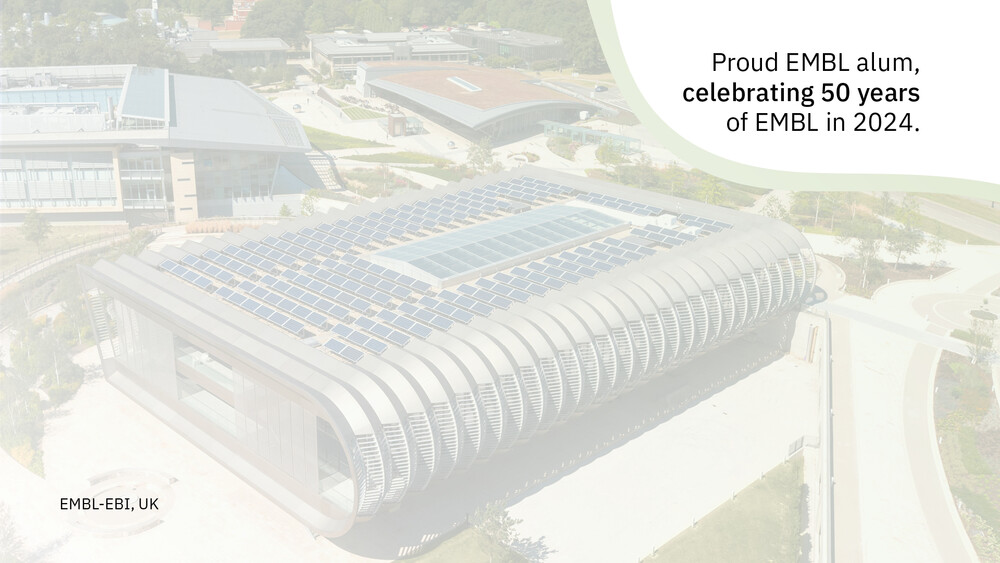
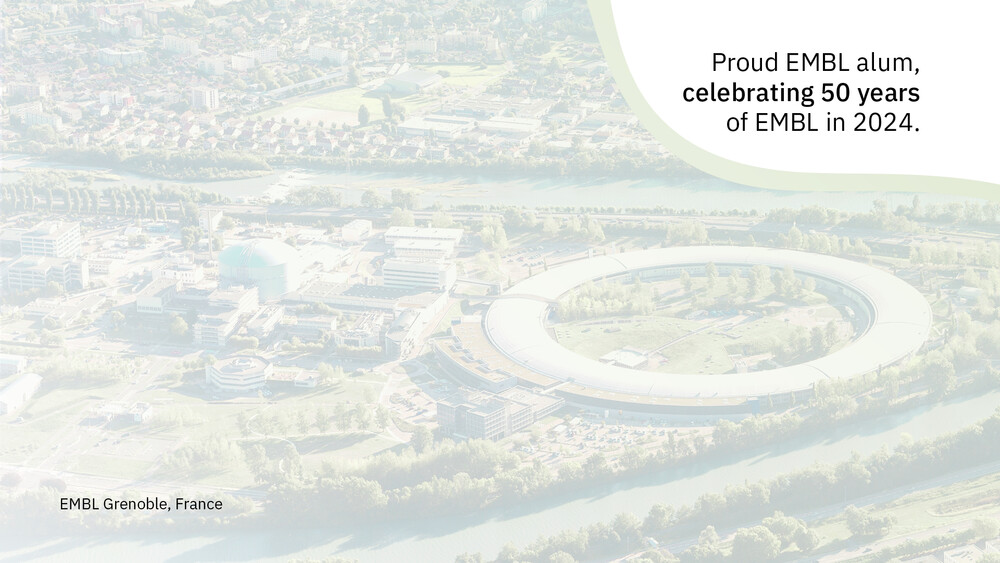
We have created a number of custom images which are available for use as Zoom backgrounds, desktop wallpapers, or screensavers. Check out the selection here.
Include EMBL in your presentations
When appropriate, choose a slide from the collection noted below to include in your presentations on various occasions during 2024:
Talk about EMBL
Want to talk about EMBL but could use some facts, figures, or other conversation starters? We’ve got you covered. Here is a list of various talking points about EMBL:
General
- Created in 1974, EMBL has five missions: research, scientific services, training, innovation and translation, and integrating life sciences throughout Europe and beyond.
- EMBL’s 2022-26 scientific programme, ‘Molecules to Ecosystems’, ushers in a new era of science in Europe, probing the molecular basis of life in context. It targets global challenges, such as the emergence of pathogens, loss of biodiversity, spread of antimicrobial resistance, as well as the impacts of pollution, climate change, and food insecurity.
- This is the first pan-European life science programme for environmental and human health. As such, it sets out a bold scientific vision that is already inspiring collaboration across disciplines and between academia, industry, and private research organisations.
Research
- EMBL’s research areas span a range of biological disciplines, including structural biology, genome biology, cell biology, developmental biology, tissue and organ biology, neurobiology, microbiology, bioinformatics and computational biology, and molecular medicine.
- In its newest programme, EMBL has introduced planetary biology, human ecosystems, infection biology, microbial ecosystems, theory, and data science.
- These themes aim to address some of the most challenging scientific and societal questions and have fostered new collaborations inside and outside of the organisation.
Scientific services
- EMBL’s scientific services enable scientists from EMBL member states and beyond to access the expertise, technology, and data needed to accelerate their science and address global societal challenges.
- For example, EMBL-EBI develops and maintains more than 40 open community databases and over 100 tools. Over 41 million people worldwide use these EMBL databases and software tools.
- EMBL’s scientific services encompass over 40 bioinformatics and data resources, and more than 20 experimental services in the fields of structural biology, imaging, genomics, proteomics, metabolomics, in vivo gene editing, and chemical biology.
Training
- A proven training ground for scientists at all career levels, EMBL provides world-class theoretical and hands-on education in collaborative, interdisciplinary environments.
- EMBL is also committed to innovative training approaches, leading to new kinds of fellowships, like the ARISE programme, which trains engineers and technology developers to become research infrastructure leaders.
- A Scientific Visitors Programme allows for shorter EMBL experiences focussed on in-depth knowledge-sharing.
Innovation & translation
- EMBL is inherently a place where the earliest seeds of innovative solutions to real-world problems are sown through fundamental research.
- With the help of EMBLEM, EMBL’s tech transfer arm, this environment creates open innovation, successful public-private partnerships, and spin-offs.
Science leadership in Europe and worldwide
- EMBL has 28 member states, two prospect member states, and one associate member state, and collaboration is a vital principle of EMBL’s activities.
- EMBL fosters international collaboration between scientific communities in and beyond Europe by playing a role in advising international and national actors on scientific strategy and policy to make the voice of life sciences heard in the international arena.
People, processes, and places
- EMBL’s staff-led sustainability strategy has provided ways to significantly reduce environmental impacts by 2030 with goals for reducing energy consumption, use of plastics in labs, and work-related travel.
- EMBL’s equality, diversity, and inclusion strategy aims to create a more inclusive research and work culture that leverages diversity in its broadest sense.
- EMBL’s open-science policy provides for databases and software to be made freely available wherever possible and encourages open-access publication.
- EMBL recognises the value of a broad range of scientific outputs and the need to assess them based on their intrinsic merit. As such, it was one of the first organisations to adopt principles of the Declaration on Research Assessment (DORA).
Share your EMBL story
Your stories are part of EMBL’s story. During our anniversary year, we will run a social media campaign to highlight the stories we hear from wider EMBL family and friends. Follow #EMBL50 on LinkedIn and X (formerly known as Twitter), and use the hashtag to share your memories, impressions, and comments.
Alumni are always welcome and encouraged to contribute photos and stories. Whether it’s outcomes from past EMBL research, the way your work continues to make a difference, or just memories from your time at EMBL, we want to hear from you. Contact alumni relations at alumni@embl.org.
Here are some ways we’ve used materials we’ve received from alumni: Outcomes of EMBL fundamental research.
Support EMBL
The core of EMBL’s work is funded by member state contributions and grants. Private support helps us to go even further, to realise bold, creative new ideas, to nurture the scientists of the future, and to help our research tackle some of the world’s biggest challenges. We are grateful to our supporters – individuals, foundations, and companies whose generosity allows us to follow extraordinary scientific pursuits and share our passion for science in inspiring ways.
EMBL’s 50th year provides an opportune time to invest in the promise of Europe’s life sciences laboratory. Click here for ways to be part of this exciting time and offer financial support.