Developmental biology
Scientists in the Developmental biology unit seek to understand the fundamental principles that govern multicellular development.
How single cells give rise to complex organisms
All the essential information on how a whole multicellular organism develops from a single cell is stored in that organism's genome and epigenome. Thousands of genes are switched on and off in a precisely coordinated manner.
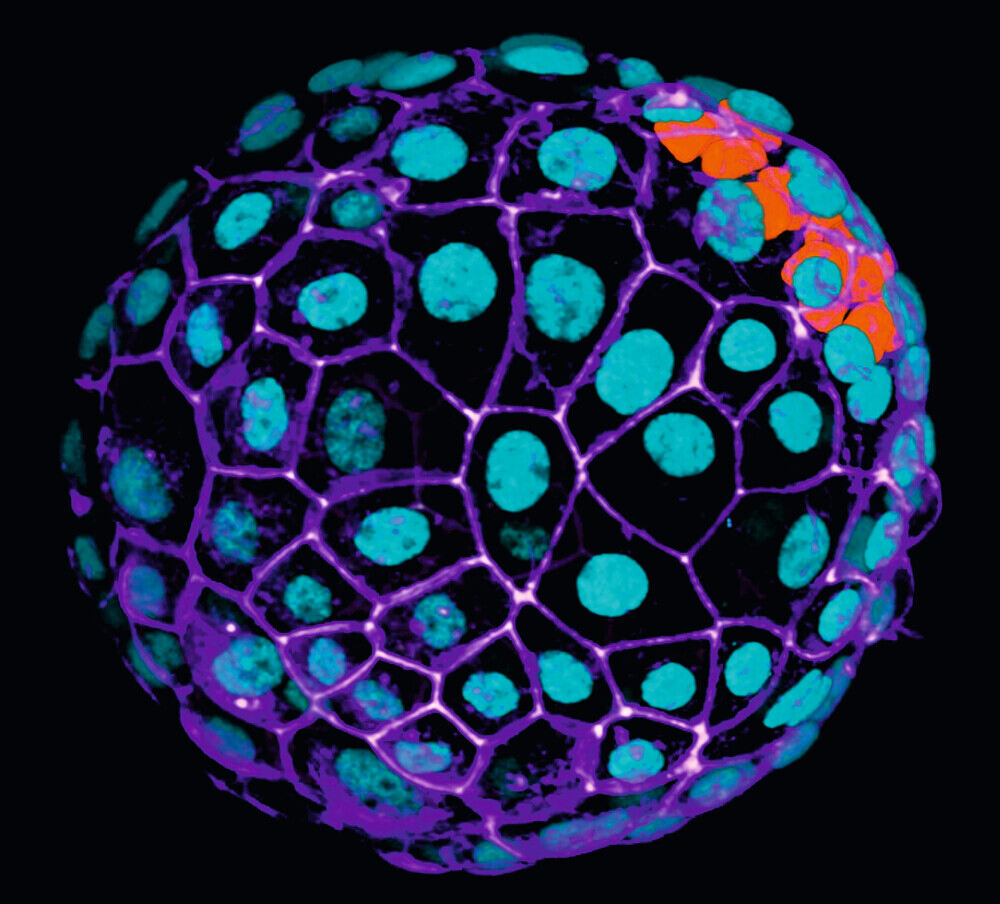
This enables individual cells to specialise in particular tasks and to arrange themselves into tissues and organs in the right locations. The developmental process is also influenced by environmental factors, such as the availability of nutrients.
Scientists at EMBL investigate the processes associated with embryo and organism development. They try to understand how embryos transition from a ball of identical cells to structured organisms with highly specialised tissues. The influence of mechanical stimuli and environmental factors on development are also investigated. EMBL scientists try to understand how biological rhythms create waves of activity of genes or signalling molecules, which helps to establish regular structures and tells organs where to form. Alongside traditional lab methods, bioinformatics approaches are also used to explore the processes of development.
Scientists in the Developmental biology unit seek to understand the fundamental principles that govern multicellular development.
At EMBL Rome, scientists explore the connections between genome, environment, and neural function.
The Genome biology unit uses and develops cutting-edge methods to study how the information in our genome is regulated, processed, and utilised, and how its alteration leads to disease.
Scientists at EMBL Barcelona use advanced technologies to observe, manipulate, and model how changes in genes percolate through cells, tissues, and organs, in health and disease.
About the teamWe are seeking a skilled and highly motivated Bioinformatics Developer to join the Human Genomics Team at EMBL-EBI and contribute to the maintenance and development of the DECIPHER platform. DECIPHER is a global data sharing platform that fuels rare disease discovery and enables patien...
Closes on 9th October. Posted 17th September 2026
EditAbout the team/jobSafety and toxicology concerns remain one of the most persistent challenges in drug discovery. This is an exciting opportunity to join a multi-disciplinary team on a project to develop a comprehensive open source side effect resource for the scientific and pharmaceutical community,...
Closes on 12th October. Posted 14th September 2026
EditThe Dorrity group at EMBL Heidelberg is seeking a motivated and skilled molecular biologist to join as a Laboratory Officer. Our group uses cutting-edge single-cell genomic techniques to study how cells regulate gene expression over time, with the goal of understanding how individual cells make deci...
Closes on 1st October. Posted 10th September 2026
EditEMBL Grenoble is a leading centre for molecular structural biology, bringing together an international community of scientists, engineers, and support professionals. At the interface of structural biology and cell biology, we investigate fundamental questions in RNA and infection biology, eukaryogen...
Closes on 1st October. Posted 10th September 2026
EditFrom microscopy to mycology, from development to disease modelling, EMBL researchers cover a wide range of topics in the biological sciences.