
Rory Bufacchi
Senior Research Scientist
EditWe develop interpretable, normative models of brain-body-environment interactions to understand how animals adapt their behaviour and neural responses.
We investigate how animals use computational principles to respond to their environment through two complementary approaches:
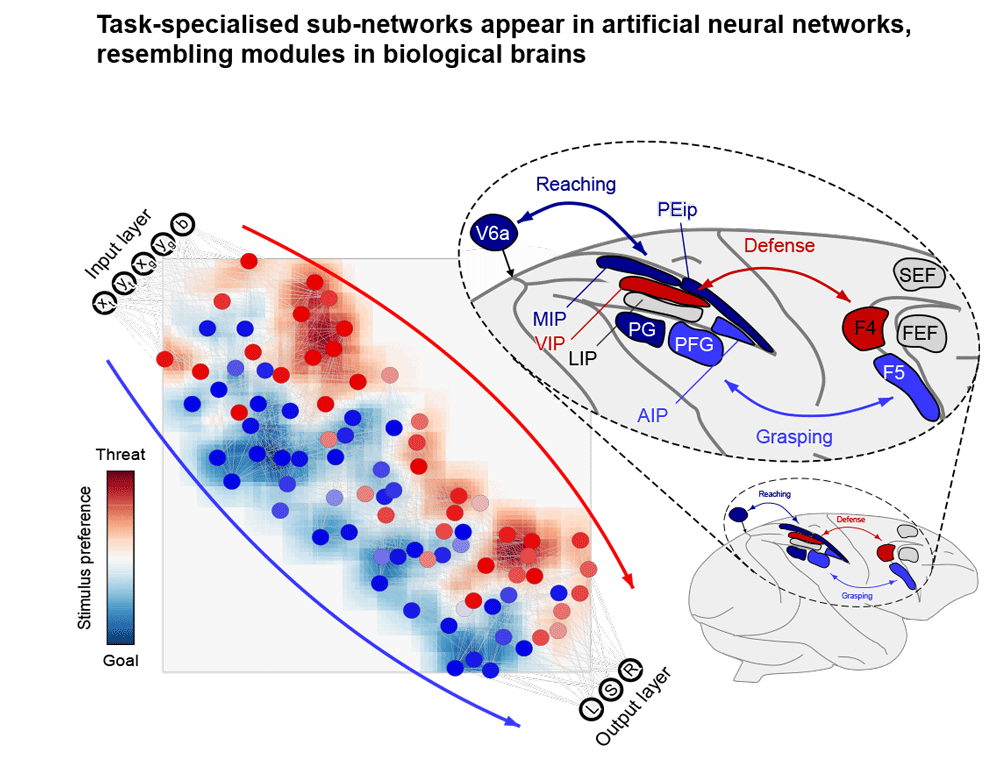
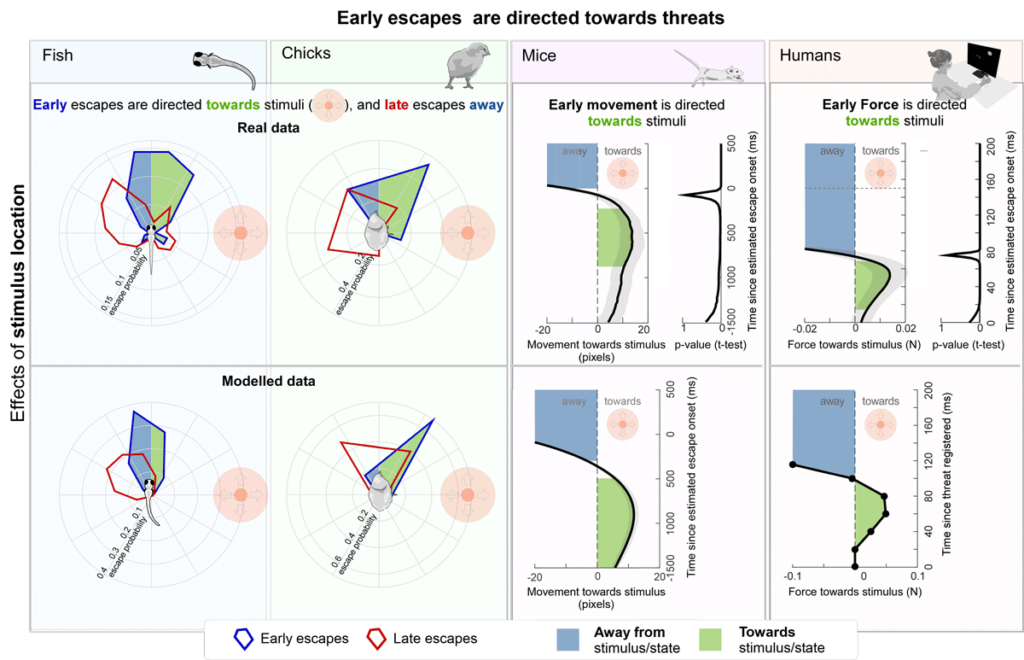
Our modeling work has demonstrated that the body-part-centric receptive fields found in certain neurons naturally emerge from the need to act on the environment. These neurons collectively form an adaptive egocentric map that allows animals to handle novel tasks and challenges (e.g. TiCS 2018, Nat Neurosci 2025; Fig. 1, 2). We are currently expanding this Reinforcement Learning model into an Active Inference framework, to enable more fine-grained modeling of neural data. We are also using an Active Inference approach to explain counterintuitive behaviours, such as why animals tend to escape toward rather than away from threats when they initiate responses too early (Fig. 3).
Our analysis of empirical data has focused on understanding how neural oscillations and responses to salient stimuli link to behaviour, inference and learning. We have characterized how nervous systems exploit environmental regularities to predict sensory input, both through ultralow-frequency neural entrainment and through selective transient responses (e.g. PLoS Biol 2020, Cereb Cort 2021). Current projects include using resting-state, neural-event-triggered fMRI to investigate motor cortex activation during memory consolidation in sleep.
Future work centers on creating normative models for a range of environments and behaviours, providing interpretable regressors for mapping function onto neural structures. We are looking to develop models that predict interception and escape behaviour, interpret subcortical electrophysiology in defensive decision-making, infer latent neural states from calcium imaging and pupillometry, and describe cellular and epigenetic autopoietic processes. This integrated approach bridges theoretical neuroscience with experimental data to understand how adaptive behaviour emerges from neural computation.
Senior Research Scientist
EditAt EMBL Rome, scientists explore the connections between genome, environment, and neural function.
Shaping the role of artificial intelligence (AI) and machine learning in the life sciences
EMBL’s site in Italy is a centre for research in Epigenetics and Neurobiology