PPMS online booking
Access for internal users only
Find out how to book MACCF equipment and services.
The facility offers researchers access, support and training into cutting-edge instrumentation and unique knowhow related to automation for microbial work at scale. Our systems enable modular workflows and allow researchers to combine equipment according to their experimental needs. Our focus is on high-throughput cultivation, genetics and phenotyping of microbes and their communities.
After an initial discussion with the user, MACCF staff advise on suitable instrumentation, program and test the automation according to individual needs, and provides hands-on support in experimental setup, execution and data analysis. Experienced users can book and use the different machines following SOPs we have established.
Access for internal users only
Find out how to book MACCF equipment and services.
The expertise of the staff combined with the automation enables high- throughput cultivation of different species, strain collections and communities. Our core experience lies on human-associated bacteria (and their viruses) and fungi, but we are open to work together with experienced researchers on microbes of other environments and other unicellular organisms – archaea, protists and algae.
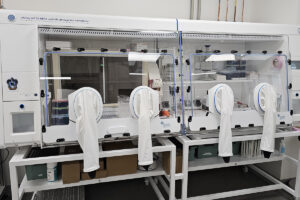
The facility houses 4 large environmental chambers, connected to customizable gas mixtures to provide precisely controlled atmospheres and temperatures, for the cultivation of a wide range of microbes, from strict anaerobes to microaerophiles, and from psychrophiles to thermophiles. These chambers are routinely used for cultivation and phenotyping of human associated microbiomes.
The facility has 9 further incubators/shakers, where different variables (temperature, light, atmosphere, shaking, humidity) can be controlled to support cultivation of diverse microbes.
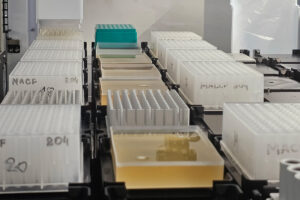
With 3 automated and 5 semi-automated liquid handlers, the MACCF supports versatile liquid handling protocols on multi-well plates (96-, 384- formats) of different sizes/volumes, for different purposes related to cultivation:
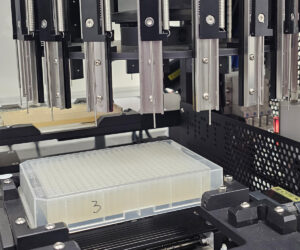
A main goal in microbial work is to isolate particular species/strains from microbiomes of different complexity. With the colony picker and the single-cell dispenser, housed within controlled environments, the facility supports:
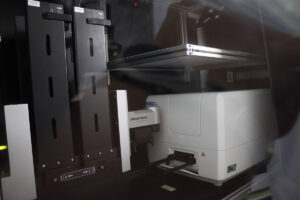
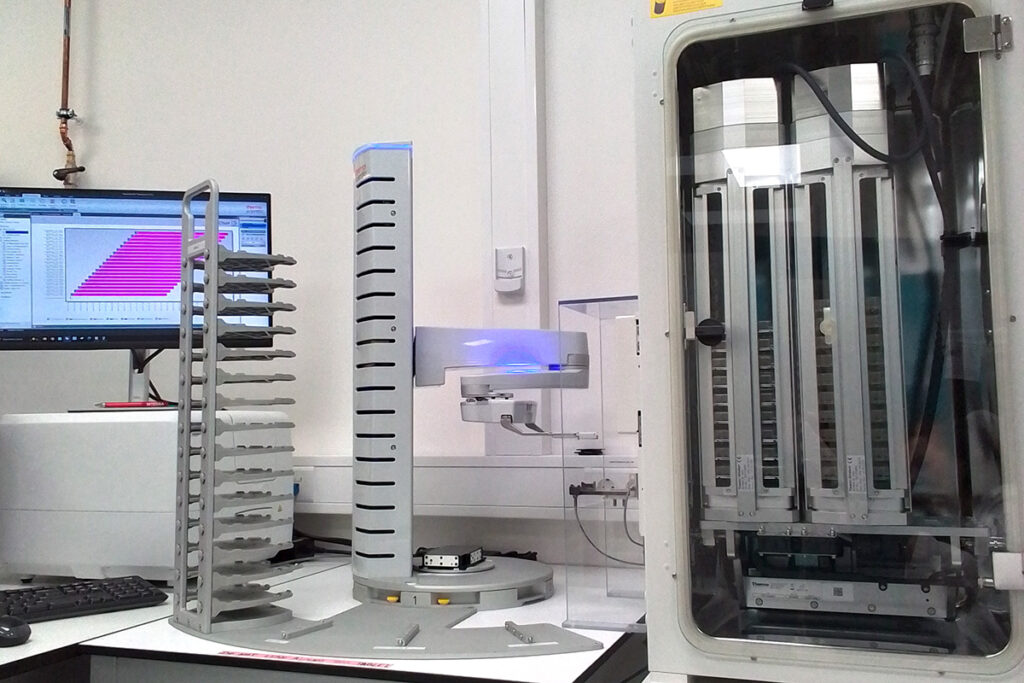
We offer integrated platforms combining stackers/ shakers housed within controlled chambers, and linked to multimode plate readers via robotic arms. We have also high-capacity for liquid handling to assemble assays/screens, and multimodal plate readers that combine even microscopy and single-cell readouts. Within this setup we can support a variety of HTS, from compound screening to large-scale phenotyping of microbes and their interactions:
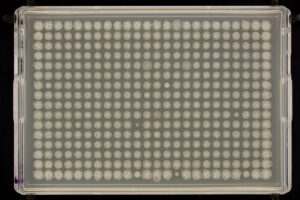
Arrayed libraries of microbes (mutants, species collections) can be pinned on high density format on agar (96, 384, 1536, 6144 colonies per plate) and assayed in 100’s of conditions – from media requirements to different chemical stresses or drug libraries. The readouts can include growth (colony morphology), enzyme production (colorimetric), biofilm (colony morphology) or interactions. Plates can be grown on different environments and imaged with a versatile setup we have to allow for epi and trans illumination, fluorescence and luminescence detection. Colony phenotypes are analyzed by in-house software.
We offer high-throughput imaging flowcytometric analysis, which can be used to monitor live pathogenic cells, count cells and subpopulations within microbiomes, and for fitness competition assays in simple/complex environments. Samples can be used past analysis for other assays, including for sorting.
We support automated live cell assays, from slide scanning to time-lapse combined with a multimode reader. Our setting allows for widefield fluorescence, brightfield and phase contrast microscopy under controlled environments (temperature, CO2, O2-controlled) and for live S2 samples. Single cell parameters, including growth rates and fluorescence signal (reporters) can be quantified on 96/384-well plates.
The facility has extensive knowhow on the generation and manipulation of genetic libraries (mutant, overexpression) in both model and gut bacteria. These libraries can be generated barcoded in pools, where barcode sequencing allows for large-scale fitness-dependent assays. They can also be arrayed so phenotypes can be assessed for each mutant separately (in high-density arrays), allowing for studying processes that are cell-autonomous (extracellular) or fitness-independent. The MACCF can train researchers in the design, construction and use of highly-saturated barcoded transposon mutant libraries in diverse microbes. This comes on top of the numerous available mutant and overexpression libraries available in the MACCF for use in experiments.
We charge an hourly usage fee as a contribution to our maintenance and consumables costs.