Contact
EMBL Heidelberg
Meyerhofstrasse 1
69117, Heidelberg
Germany
Tel: +49 6221 387-8051
E-mail: maccore@embl.de
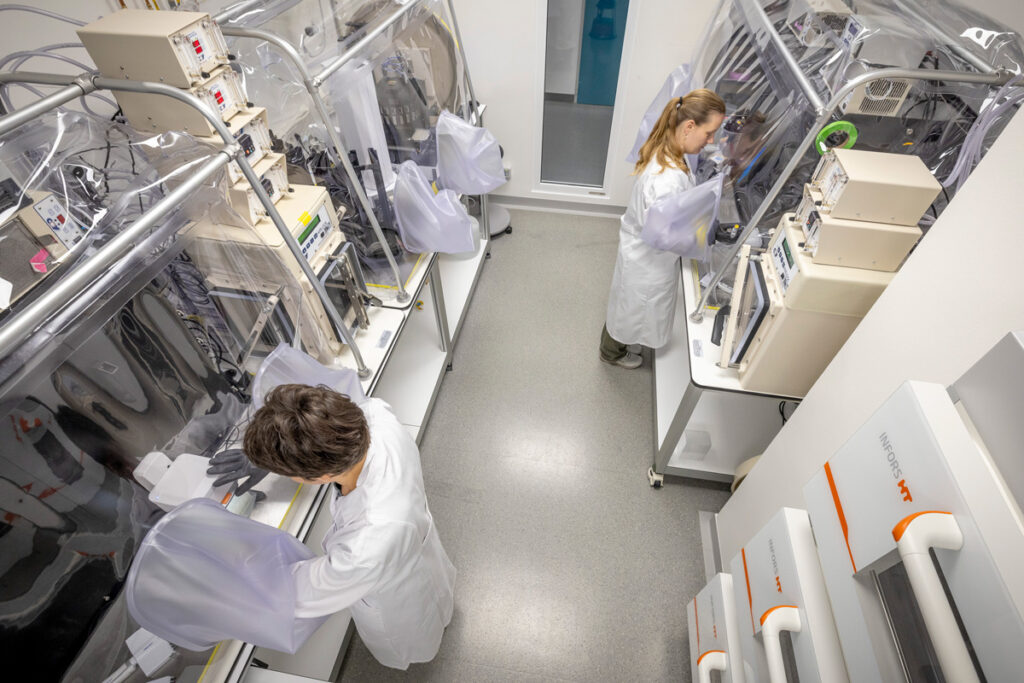
The facility is set entirely in Biosafety Level 2 space and gives researchers access and training to cutting-edge instrumentation and automation for microbial work at scale.
The Microbial Automation and Culturomics Core Facility (MACCF) is a walk-in facility, housing robotic equipment in controlled environments, which expedite both targeted and high-throughput work with microbes and their communities.
The facility was launched in 2025, as part of EMBL’s 2022-2026 Program, Molecules to Ecosystems. We offer researchers access, training and support for project design, execution and analysis. Featuring multiple and diverse automated integrated systems in controlled atmospheres, we enable large-scale experiments with pathogens, diverse microbes (bacteria, archaea, fungi, protists, algae and phages) and microbiomes.
A particular focus is on the human gut microbiome, enabling the dissemination of pioneering tools, approaches and resources established at EMBL and its Microbial Ecosystems Transversal Theme.
EMBL Heidelberg
Meyerhofstrasse 1
69117, Heidelberg
Germany
Tel: +49 6221 387-8051
E-mail: maccore@embl.de
The facility provides unique infrastructure, tools and resources for cultivating and studying microbes and their communities at scale. We offer a variety of microbial (genome-wide mutant, microbiome and natural isolate collections) and chemical-compound libraries, access and training to equipment that enable high-throughput cultivation, perturbations (genetic and chemical) and phenotyping under controlled environments.
We are here to help you design and analyze your experiment or screen. Access for EMBL users began in July 2025, and we will further open to external academic users in the near future. Please contact us to explore how the facility could support your research.