Cultivation, isolation, liquid handling
Controlled environments
We operate one DWS M155 and 3 COY chambers, which allow for precise atmospheric control for the cultivation and manipulation of anaerobes and microaerophilic microorganisms. Each chamber is equipped with a variety of robots, incubators, plate readers/stackers to enable a wide range of applications, including high-throughput microbial/microbiome culturing, genetics and phenotyping. The DWS chamber has a cooling system, and also allows facile introduction of additional equipment for tailored experiments.
We also offer three Multitron shaking incubators (Infors HT), which can support both flask or plate incubation in temperature (4 – 65°C), CO2 (0 – 20%) and humidity-controlled environments. One incubator can accommodate 72 microtiter plates or 24 2ml deep well plates and shakes with3 mm shaking throwto achieve high speeds (up to1,000 rpm) and appropriate aeration of microbial cultures.
The facility has three incubators under controlled CO₂ atmospheres or humidity conditions. Our large PHCBI incubator can accommodate large numbers of agar-based plates – and allows for control of CO₂ and humidity. Four other smaller incubators are used in different setting and enable the growth of a diversity of organisms.
Liquid handling
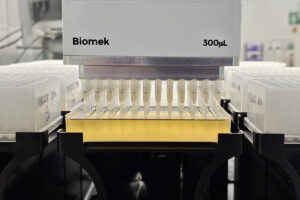
Biomek i7 liquid handler (Beckman Coulter)
A highly versatile and flexible liquid handling platform with 43 deck positions (including add-on features – heating, cooling, shaking, tubes), which offers precision pipetting in multi-well plates with a 96-channel head, and an 8-channel head for individual transfers and cherry picking. We customize workflows to streamline and automate diverse applications such as assay plate set-up; sample distribution, dilution, pooling and arraying; and nucleic acid extractions and NGS library preparation.
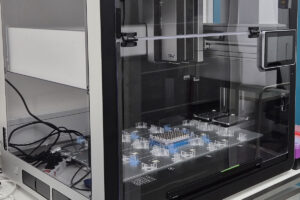
Flex Prep liquid handler (Opentrons)
A liquid handling platform that automates routine pipetting tasks, with a 96-channel head and two 8-channel heads. It is equipped with a gripper and two stackers that accommodate up to 48 flat bottom plates. The HEPA/UV Module allows handling of bacteriophages.
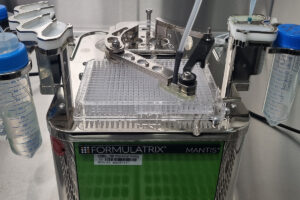
MANTIS Liquid Dispenser (Formulatrix)
A compact, low-volume liquid handler designed for precision dispensing. It features a microfluidic chip system that delivers volumes from 100 nl to ml with high accuracy, compatible with media, DMSO, glycerol, and cell suspensions. The system accommodates well plates, tubes and custom plate templates and automatically dispenses up to 6 reagents with a wide chemical compatibility. It is compatible with the environmental chambers.
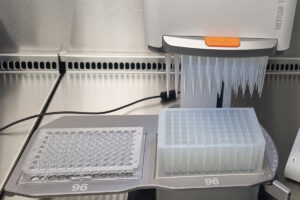
MicroPro 20, 300, 1250 (Mettler Toledo)
5 flexible and portable small pipetting systems with a 96 pipetting head allowing semi-automated transfers in 96 or 384 well plates.
Microbial isolation
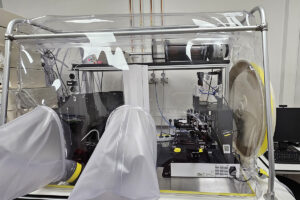
RapidPick Lite Colony Picker (Hudson)
Integrated with a robotic arm and stackers, the colony pinner enables fast and informed picking (2500 colonies/hr) from a variety of plates to target ones (agar or liquid). The system is placed inside a COY environmental chamber.
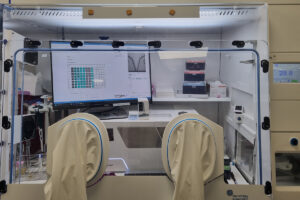
B.SIGHT Single-Cell Dispenser (Cytena)
A benchtop instrument for dispensing single microbial cells of size 0.5-15 µm, based on size, roundness and fluorescence. It combines high resolution optical microscopy and real-time image analysis. Its small footprint makes it compatible with the environmental chambers.
High-throughput phenotyping
High-density pinning arrays
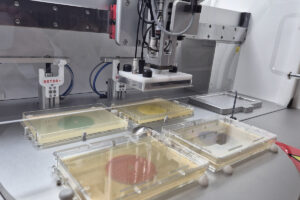
ROTOR+ (Singer Instruments)
A pinning robot for transfers of high-density microbial arrays of a wide range of formats – 96, 384, 1536 and 6144-colonies. It uses plating pads to transfer cells from and to agar or liquid plates (liquid transfers for 96/384-well plates). Ideal for replicating, (re)arraying and for high-throughput screens (genetics or chemical genetics). A genome-wide mutant library of E. coli can fit on 3 plates of 1536-colony arrays and be rapidly screened in tens to hundreds of conditions.
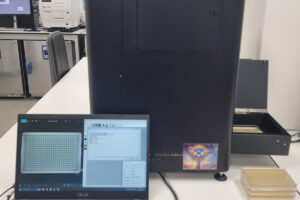
spImager-SA Imager (S&P Robotics)
A semi-automated system for capturing high-resolution images of colonies with epi and trans- illumination. It allows flexibility in camera settings, intensity and labware type.
Phenobooth+ Colony Counter (Singer Instruments)
A system for colony imaging and counting on solid media, capable for detecting GFP, YFP, BFP, mcherry. Its integrated software provides automated batch analysis, enabling colony filtering by size, circularity, color, and brightness. It’s compatible with the DWS environmental chamber for imaging oxygen-sensitive microbes.
Integrated shaker-incubators & plate readers
The facility houses a Cytomat 2C470-LiN incubator (Thermo Fisher) with two tower shakers for shallow well-plates in a temperature (4 – 70°C), moisture and gas (O2, CO2, N2) controlled environment. It is integrated with a robotic arm to the multimode plate reader Agilent Synergy and four hotels for plate entrance and exit. The automation allows for recording of up to 60 multi-well plates (single time point) or 32 plates for kinetics (multiple time points).
The facility also features two incubators (build-in house) accommodating Biostak3 stackers linked to either a multimode plate reader (Agilent Synergy) or an Epoch microplate spectrophotometer. These are housed inside the 2 COY environmental chambers, and allow for time-resolved measurements of up to 30 multi-well plates per incubator.
Plate readers
The facility houses 6 plate readers, some as stand alone, others in integrated workflows or inside chambers to expand the utilities and microbes probed. Specifically we have:
Biotek Synergy H1 (Agilent) – 3 x
This multimode microplate reader combines monochromator- and filter-based optics for high-performance detection. It supports absorbance, fluorescence, and luminescence assays in various plate formats (up to 384-well), includes temperature control (up to 45°C) and the Gen5 software for data acquisition and analysis. Currently these thee H1 plate readers exist: i) as a stand-alone instrument for individual plate measurements, ii) integrated in the Cytomat – automation set-up for automated reads of multiple plates and time points, iii) available in Coy environmental chamber in conjunction with a BioStak3 for automated data acquisition of multiple plates and time points.
Biotek Epoch (Agilent)
A compact, monochromator-based microplate spectrophotometer designed for absorbance measurements. It supports various read modes, including endpoint, kinetic, spectral scanning, and well area scanning, accommodating various plate formats (up to 384-well). The Epoch is housed inside a COY environmental chamber in conjunction with a BioStak3 for automated data acquisition of multiple plates and time points.
PlateDirect A96 Plate reader (Mettler Toledo) X 2
Two plate readers are present in the facility and support reading of defined wavelengths.
- 450nm – 492nm – 578nm – 620nm
- 405nm – 578nm – 600nm – 650nm
Imaging flow analysis
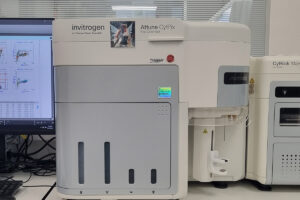
Attune CytPix Flow Cytometer (Thermo Fisher)
The system allows for detection of live small particles (0.5 µm – 140 µm). It combines high-resolution bright-field imaging (20x) with acoustic focusing technology to ensure precise particle alignment and accurate data acquisition at a high-speed (up to 35,000 events / sec). Our instrument is equipped with a violet, blue, yellow and red laser and provides 14 fluorescence channels + FSC & SSC. Complementing the CytPix, the CytKick Max Autosampler automates high-throughput sample processing from 96- and 384-well plates, in an optional cooling manner.
HT microscopy
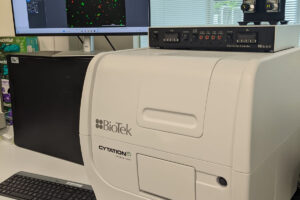
Biotek Cytation 5 (Agilent) cell imaging multimode reader
This is an integrated inverted cell imaging microscope and multimode microplate reader and can perform time-lapse live cell assays. The imaging capabilities include filter-based widefield fluorescence (currently available: DAPI, CFP, GFP, YFP, TexasRed, Cy5, chlorophyll), brightfield, and phase contrast imaging with 1.25-60x magnification and laser-autofocus. It can simultaneously monitor absorbance, fluorescence intensity, and luminescence. It accommodates different labware such as well plates, microscope and chamber slides, cell culture dishes and flasks and SBS agar/ agarose plates. The Cytation 5 allows incubation from ambient temperature up to 65°C with condensation control, CO₂ and O₂ regulation, and various shaking modes. For sensitive assays run at room temperature, the Cooling Module maintains environmental stability within Cytation at < 1 °C change. The software supports automated data acquisition, imaging and data analysis, for e.g. cell counting, cell tracking etc.
The facility houses an additional Cytation 5, which doesn’t support multimode plate reader capabilities but it’s smaller footprint makes it compatible with the DWS environmental chamber, enabling microscopy tasks of oxygen-sensitive microbes.