A hidden world revealed
Looking back on the EMBL Insight Lecture 2025
By Melanie Meihua Brauny
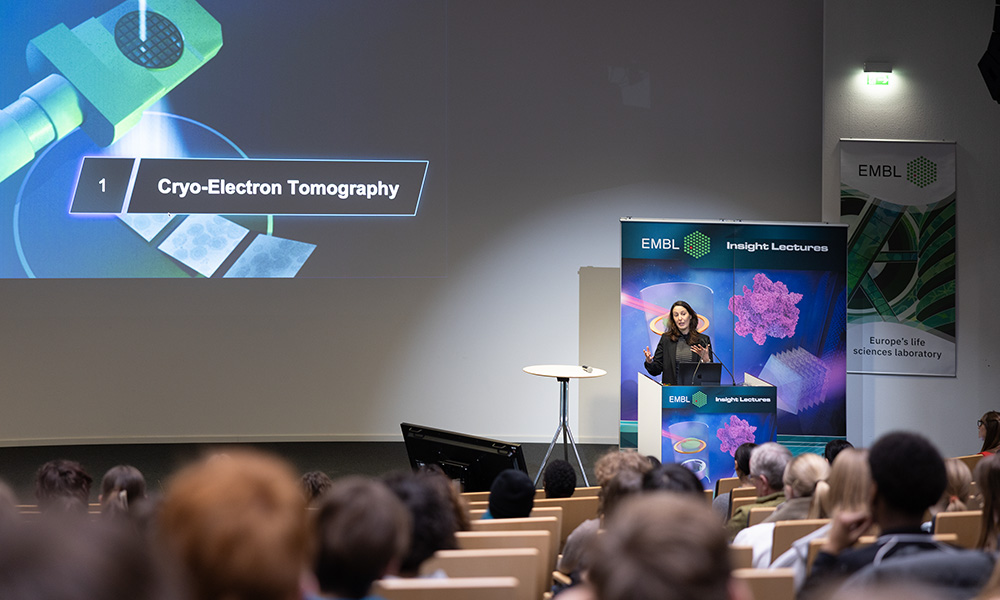
A cold winter’s day couldn’t stop over 100 curious students from coming up to EMBL Heidelberg for the 16th Insight Lecture, hosted by the Science Education and Public Engagement (SEPE) office on 16 December 2025. The excitement was not limited to Heidelberg, however, as the audience extended far beyond, with over 600 online attendees joining from over 20 different countries.
This year’s lecture took the audience on a fascinating journey into the smallest units of life. EMBL group leader Julia Mahamid opened the window to a cutting-edge technology transforming our understanding of life: cryo-electron tomography, or cryo-ET for short. In contrast to traditional structural biology methods, cryo-ET allows scientists to study the structures of small molecules not only in isolation, but within their native cellular environment – it can even show their interactions and binding partners.
Using Mycoplasma pneumoniae, a tiny bacterium that causes respiratory infections, as a model organism, Julia demonstrated how this advanced imaging technique enables ultra-high-resolution views of ribosomes associated with RNA polymerase. This reveals in striking detail, how different antibiotics can disrupt this complex and thus bacterial protein biosynthesis and cellular function. The sense of wonder continued when Julia introduced cryo-focused ion beam milling as a powerful technique for sample preparation which can carve ultra-thin sections out of larger cells or even entire organisms like C. elegans. This process enables scientists to look deeper into cells and tissues than ever before, revealing details that were previously invisible even with the best imaging techniques.
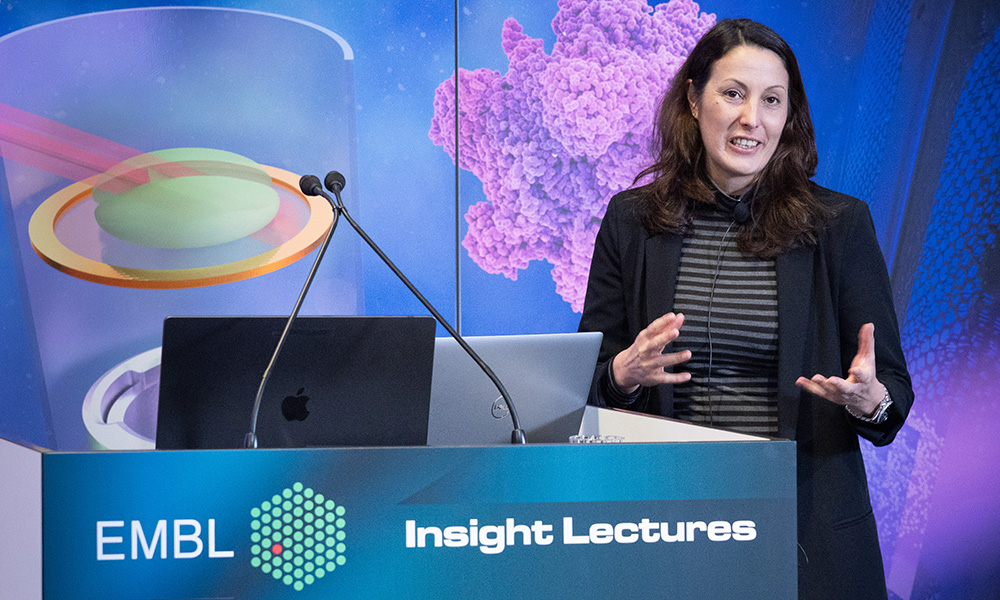
Photo credit: Stuart Ingham Bailey/EMBL
Julia concluded with an outlook on the future of cryo-ET and the very inspiring reminder that, despite these technological advances, there is still so much to be discovered – perhaps even by members of the audience themselves.
Have no fear! There is so much to do, there is so much unknown, there is so much to advance that you simply can’t fail if you just pursue it without fear!
After her talk, questions from students and teachers, online and on site, began to pour in. These ranged from questions on the technology itself (“How does the ion beam cut the sample?”) over potential future developments (“Is there a way to keep the imaged samples alive?”) all the way to blue sky ideas (“If you had a magic wand and could choose any structure to look at, which one would you take?”). Each of the questions sparked thoughtful discussions and showed the deep engagement inspired by Julia’s talk. Especially her advice to be fearless when pursuing a career in STEM, because “you simply can’t fail if you pursue it without fear” left a lasting impression on the audience.
Many students on-site in Heidelberg also used the snack session after the lecture to engage in deeper conversation with Julia while enjoying pretzels and gingerbread. Altogether, this year’s Insight Lecture once again showcased outstanding scientific innovation and collaboration and, most importantly, may have sparked curiosity and inspired the next generation of scientists.